President Al-Alimi Calls on International Community to Implement Sovereign Decisions at Security Council
Riyadh
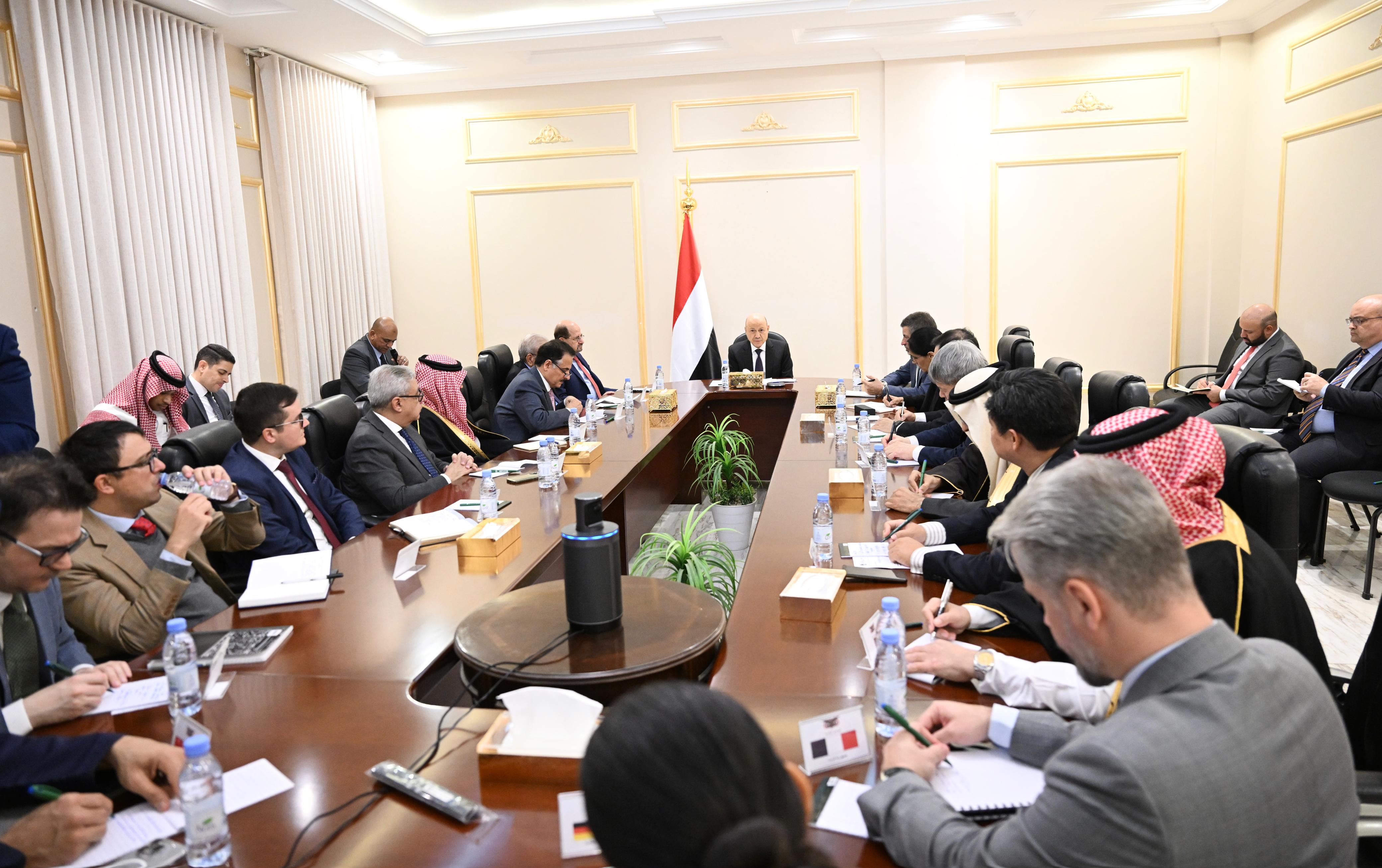
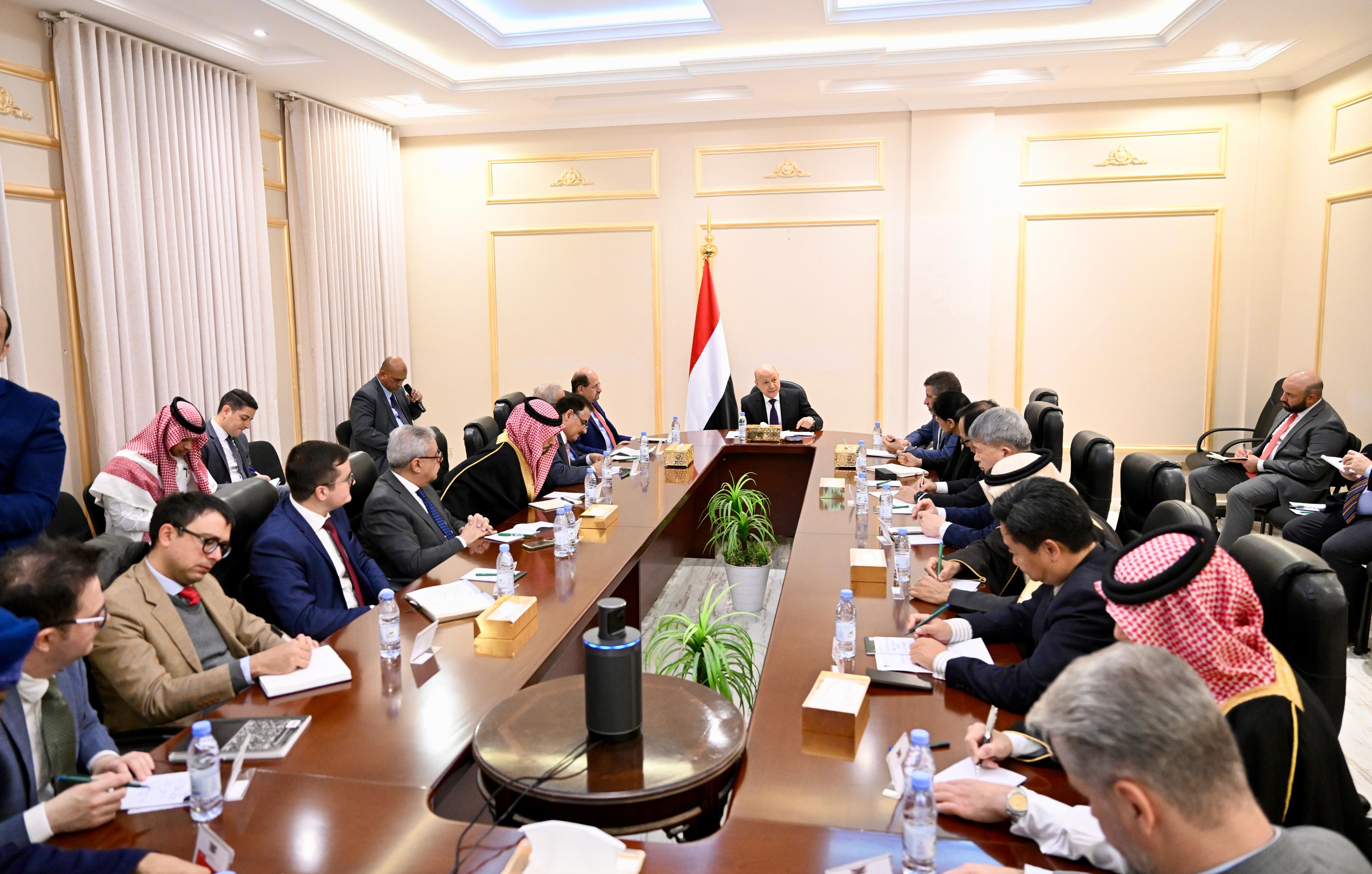
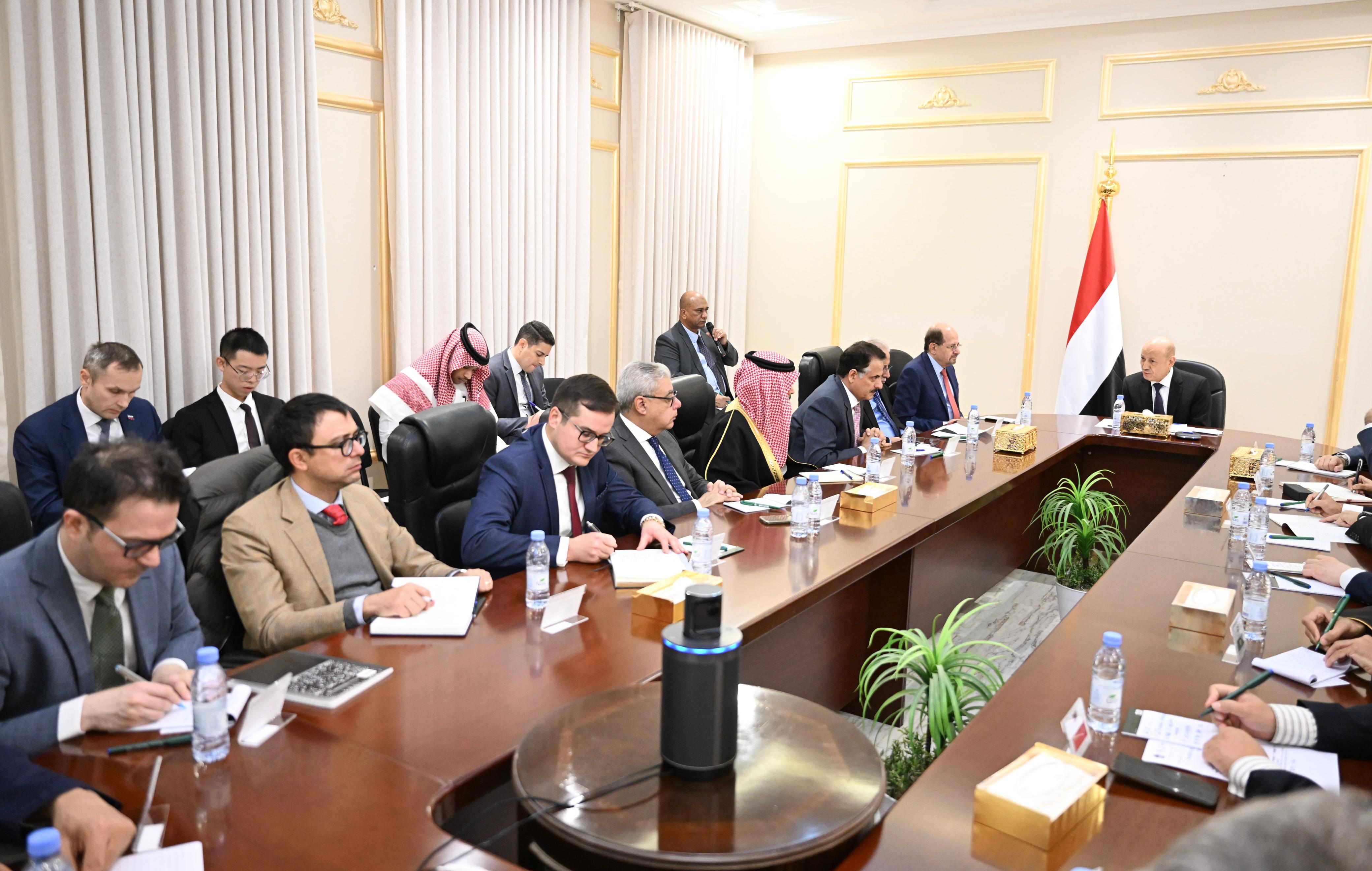
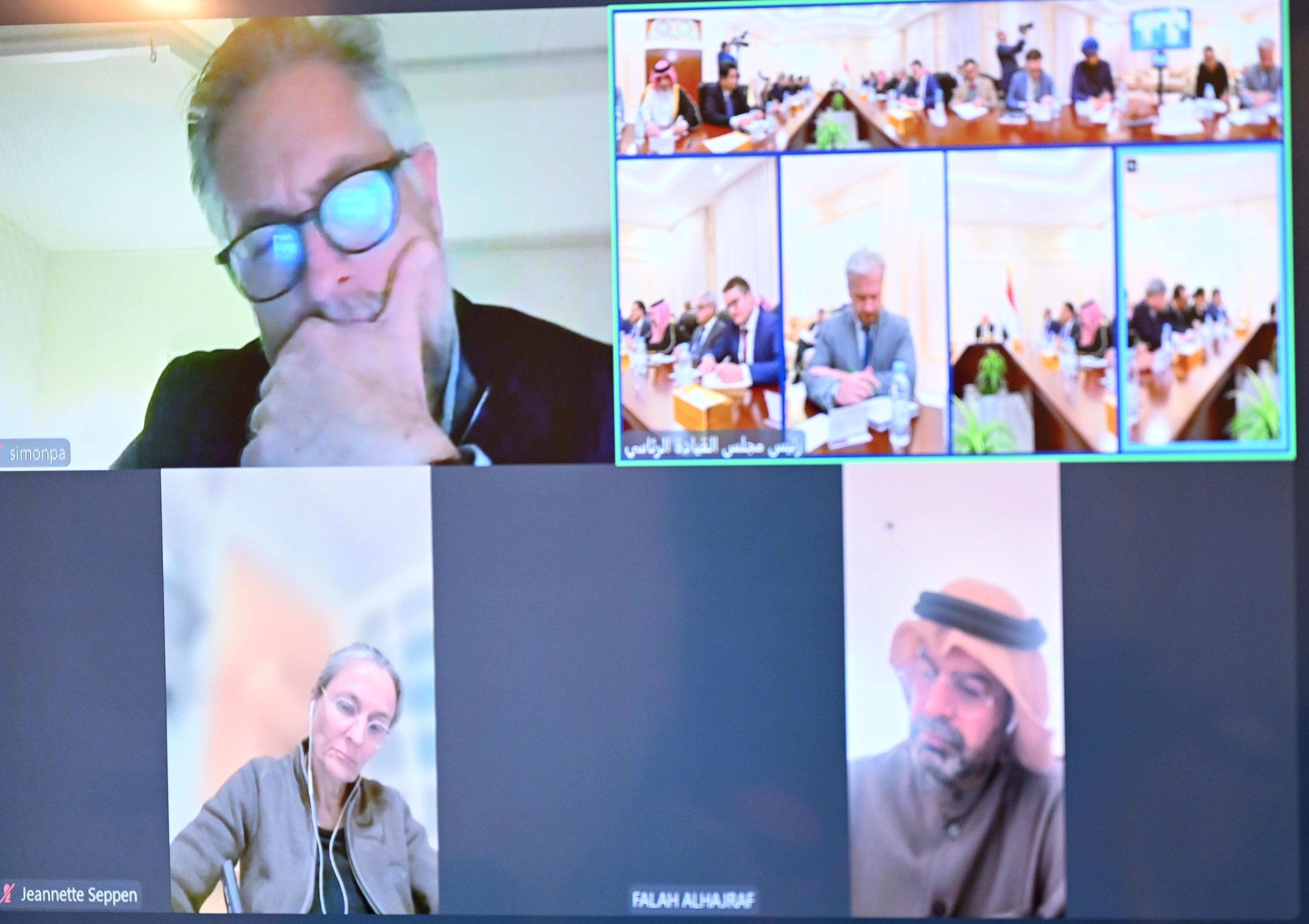
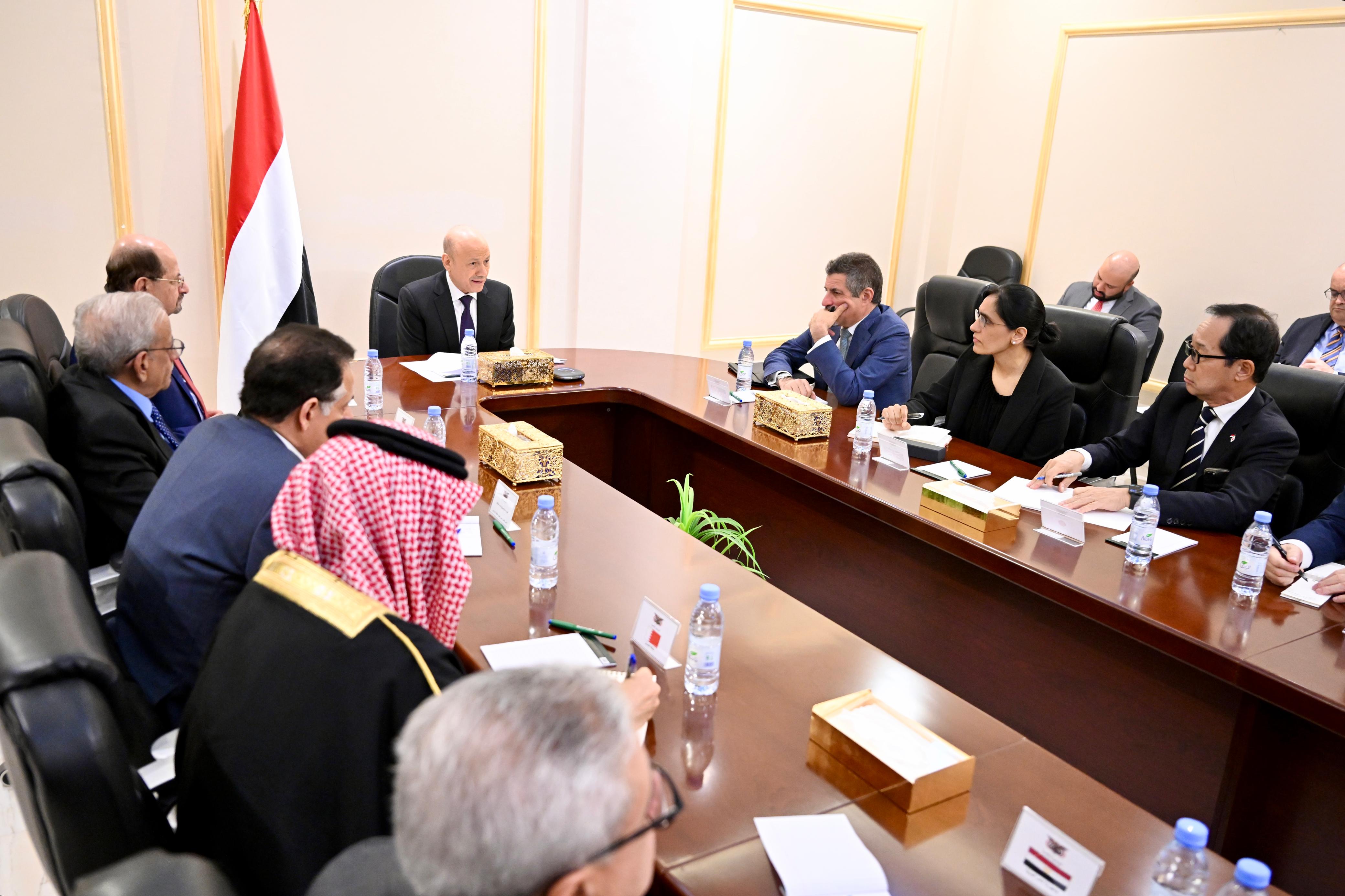
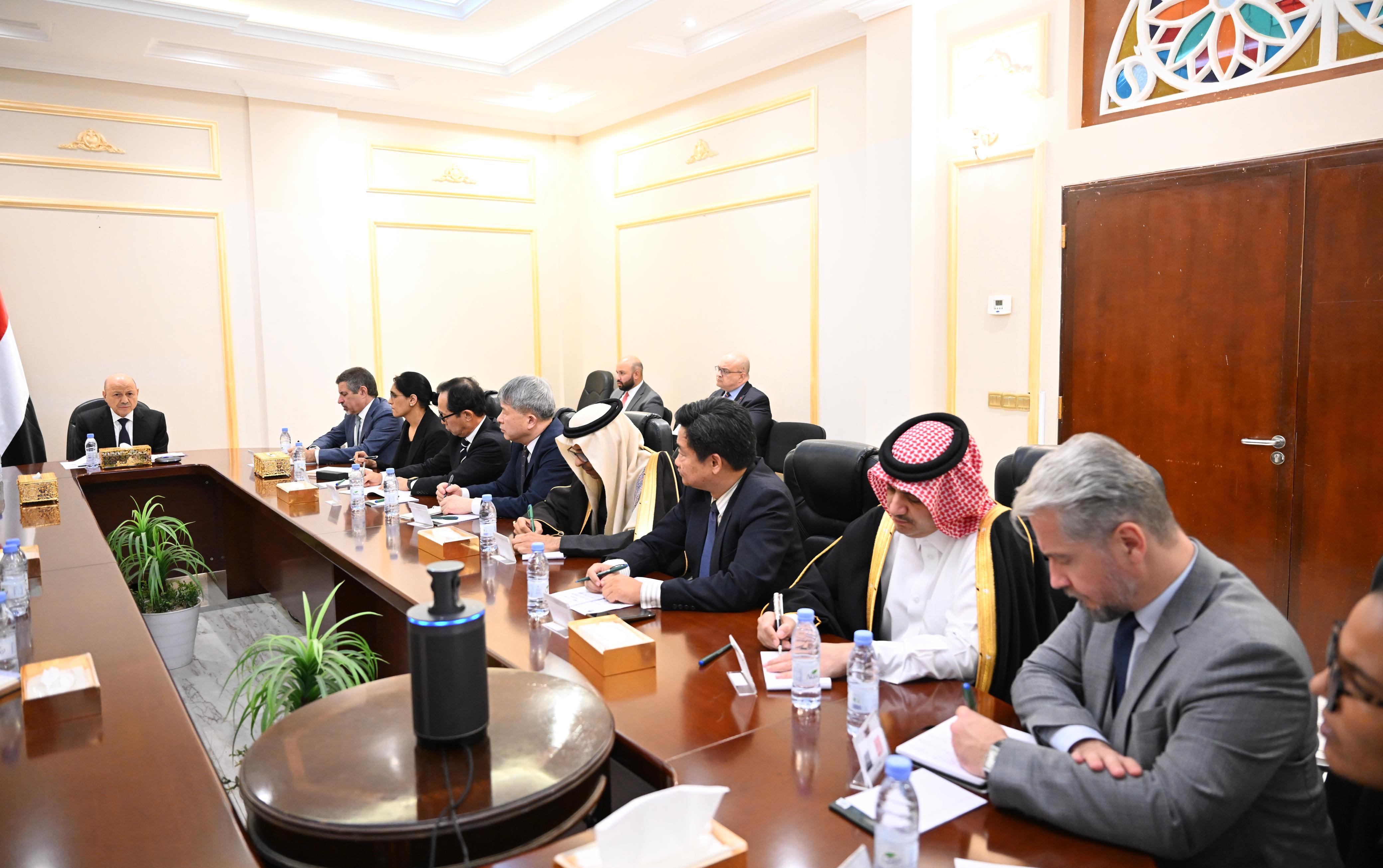
President of the Presidential Leadership Council, His Excellency President Dr. Rashad Mohammed Al-Alimi met today, Tuesday, with the ambassadors of the countries sponsoring the political process in Yemen, in the presence of Dr. Shaia Al-Zandani, Minister of Foreign Affairs and Expatriates.
The meeting focused on the latest local developments, particularly in the eastern governorates, which necessitated the adoption of a series of firm constitutional and legal decisions and measures to protect citizens’ security, safeguard Yemen’s unity, sovereignty, stability, territorial integrity, and preserve the state’s legal standing.
During the meeting, President Al-Alimi welcomed the ambassadors and highly commended the unity of their countries’ stances in support of the Yemeni people during the most difficult stages, politically, humanitarianly, and economically.
The President reaffirmed that these developments do not constitute an internal political dispute, but rather represent a threat to the unity of military and security decision-making, an undermining of the state’s legal authority, and a reproduction of the logic of parallel authorities, which the international community has consistently rejected in all its statements and resolutions.
His Excellency reviewed the extensive efforts made over the past period to de-escalate tensions and contain the repercussions of unilateral military measures taken by the Southern Transitional Council in the governorates of Hadhramaut and Al-Mahrah, outside the frameworks of the transitional phase and without the approval of the Presidential Leadership Council or coordination with the Coalition leadership. He noted that all these efforts were met with obstruction.
In this context, President Al-Alimi explained that, in his capacity as Supreme Commander of the Armed Forces, he issued explicit directives prohibiting any military movements outside the framework of the state. A three-phase gradual redeployment plan for the Homeland Shield Forces was approved, two phases of which have already been implemented.
He added, “We formed a high-level communication committee to contain the escalation and open channels for dialogue, but these efforts were unfortunately also met with obstruction and insistence on proceeding with unilateral measures.”
He stressed that this confirms that the problem was never a lack of solutions, but rather a deliberate obstruction of them.
The President refuted misleading narratives aimed at justifying the imposition of a fait accompli by force under the pretext of combating terrorism, emphasizing that counterterrorism is a sovereign state decision, not a political pretext. He pointed out that Yemen’s military and security institutions, with the support of partners, have achieved documented successes in dismantling terrorist cells, drying up their funding sources, securing cities and vital corridors, and combating arms and drug smuggling.
Accordingly, he said, the terrorism file cannot be used to justify military movements outside the framework of the state or to undermine its legitimate institutions.
President Al-Alimi reiterated the principled and firm position on resolving the southern issue through a just solution in accordance with whatever options are decided by the free popular will, while categorically rejecting the imposition of such a solution by force or weapons.
He stated that reducing the southern issue to exclusive representation or military movements undermines its just cause, weakens prospects for a sustainable political solution, and harms the people of the south first and foremost.
He noted that this position aligns with what our brothers in the Kingdom of Saudi Arabia have affirmed—that the southern issue is a just cause with historical and social dimensions, and can only be resolved at the dialogue table within a comprehensive political settlement.
The President of the Presidential Leadership Council warned that international priorities to protect regional interests, as well as the aspirations of the Yemeni people for security, stability, and decent living conditions, will be endangered by the existence of militias that do not obey state authority. He pointed out that any instability in Hadhramaut and Al-Mahrah would disrupt oil exports, hinder salary payments, exacerbate the humanitarian crisis, and undermine confidence with the donor community.
President Al-Alimi also addressed the Emirati role in the recent developments in the eastern governorates, stating that Yemen does not deny the previous role of the United Arab Emirates or its contributions in earlier stages. However, he stressed that “what we need today is clarity and neutrality from supporting any component that has deviated from the consensus mechanisms sponsored by the UAE itself within the Coalition to Support Legitimacy.”
He He explained that when the Coalition to Support Legitimacy, of which Yemen is a member, declares that there is Emirati pressure to push local forces toward military action, such actions constitute a threat to Yemeni and Saudi national security and contradict the foundations upon which the Coalition was established.
He said it is therefore his duty, as the president of a UN member state, to address the matter with the utmost seriousness and responsibility.
He added that “accordingly, requesting the withdrawal of forces that have departed from the fundamentals of the Coalition is a natural sovereign demand that does not target relations nor deny history, but rather protects the very idea of the Coalition.”
President Al-Alimi renewed his warning that the transformation of armed groups into parallel authorities poses a danger that cannot later be contained, stressing that Yemen today stands at a crossroads: either one state with one decision, or open chaos that will not stop at Yemen’s borders.
He called on the countries sponsoring the political process in Yemen to adopt a unified and explicit international stance that rejects unilateral measures and supports Yemeni state decisions as well as Saudi-led de-escalation efforts.
He also urged them to exert political and legal pressure to enable the legitimate government to exercise its exclusive authorities and to implement today’s decisions through action at the Security Council and international forums, in accordance with international law.
Concluding his remarks, President Al-Alimi said, “If the logic of the state collapses in Yemen, there will be no stability left to invest in—neither in the south nor in the north.” He emphasized that it is the responsibility of all parties to prevent Yemen from becoming another model of state disintegration, to put an end to the suffering of a people exhausted by war, and to provide them with a genuine opportunity for peace and a dignified life.
The meeting was attended by Dr. Yahya Al-Shuaibi, Director of the Office of the Presidency.

PLC President: Decision to End Houthi Terrorism Is in Force and Irreversible
President Dr. Rashad Al-Alimi, President of the Presidential Leadership Council (PLC), affirmed that “Dawn of Yemen” Operation is proceeding toward its ultimate goal

PLC Warns Against Espionage and Cooperation with Houthis, Orders Pursuit of Those Involved
Tue ، 13 Oct 2026 05:51

PLC President Affirms Yemen’s Full Solidarity with Saudi Arabia, Vows to End Houthi Terrorism
Sat ، 10 Oct 2026 05:51

PLC President: “Dawn of Yemen” Operation to Continue Until All Its Objectives Are Achieved
Wed ، 07 Oct 2026 05:51