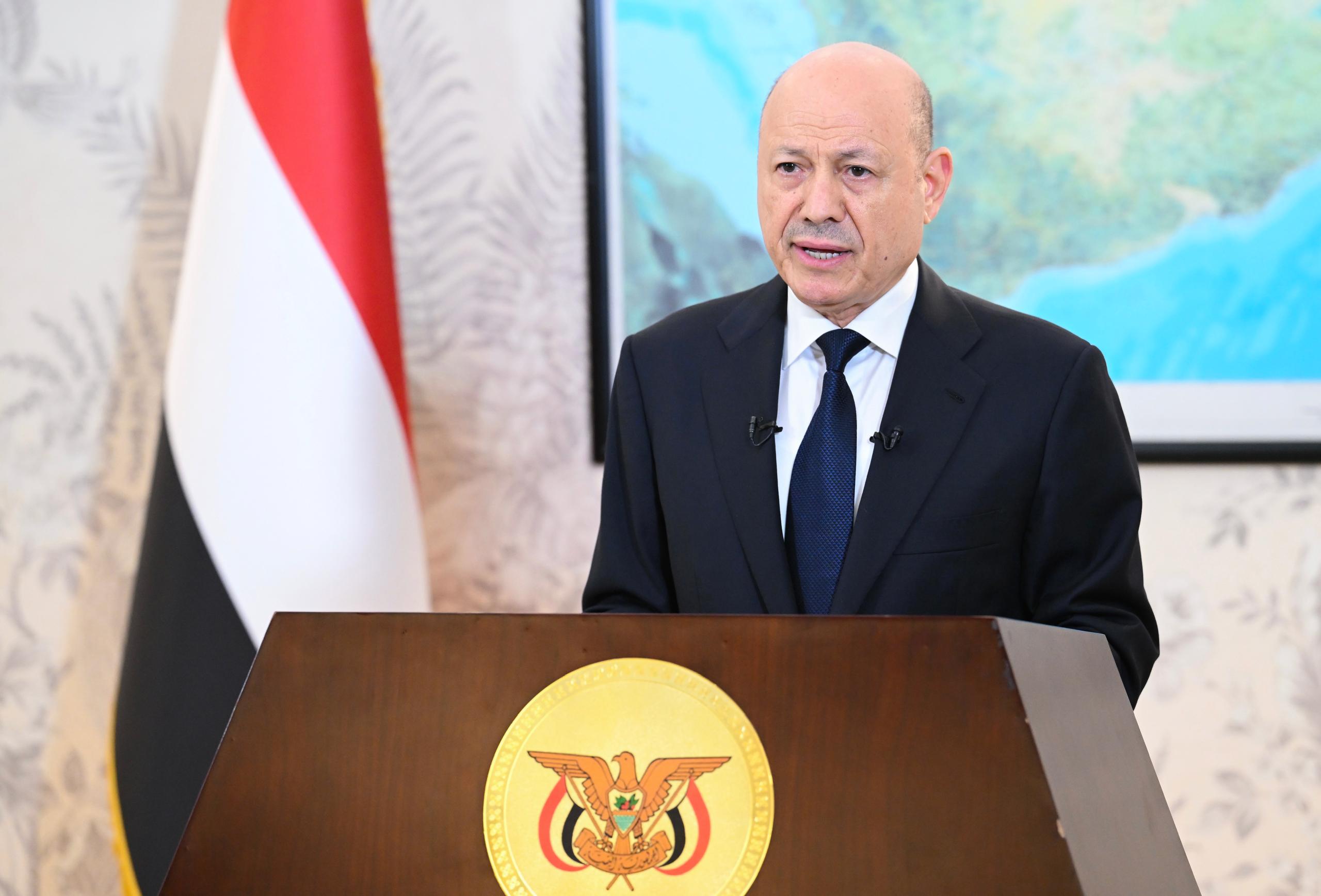
Presidential Statement: Committed to Protecting Civilians and Correcting the Course of Partnership within Coalition Supporting Legitimacy
Riyadh
President Dr. Rashad Al-Alimi, President of the Presidential Leadership Council, affirmed that the state remains committed to protecting civilians, upholding its legal framework, and maintaining unified military and security decision-making. He warned of the dangers posed by the Southern Transitional Council’s escalation in Hadhramout and Al-Mahrah governorates and highlighted the involvement of the United Arab Emirates in supporting the rebellion and undermining state institutions.
In a statement addressed to the Yemeni people, President Al-Alimi noted that recent developments in the eastern governorates, accompanied by serious violations against civilians, come at a time when Yemen continues its decisive battle against the Iranian-backed Houthi terrorist militias, amid one of the world’s most severe humanitarian crises.
Addressing citizens of southern governorates, the President emphasized that their just cause has always been central to the state’s project and that their political, economic, and administrative rights are fully guaranteed under the transitional frameworks, ensuring responsible partnership that preserves dignity and establishes lasting stability. He cautioned against monopolizing the representation of the southern cause or exploiting it for illegitimate political objectives.
President Al-Alimi stressed that, in his constitutional capacity as Supreme Commander of the Armed Forces, he had previously ordered that no military or security movements take place outside the state’s authority or without explicit orders from the top leadership, to prevent bloodshed and avoid internal clashes. However, formations affiliated with the Southern Transitional Council disregarded these directives and proceeded with unilateral movements, constituting a rebellion against state institutions.
The President highlighted the state’s achievements over recent years, with support from regional and international partners, in combating terrorism, dismantling terrorist cells, cutting off their financing, securing vital cities and corridors, and achieving progress in combating arms and drug smuggling. He reiterated that counter-terrorism is a sovereign decision exercised by the state’s competent institutions and cannot be used as a pretext for escalation.
Al-Alimi further clarified that the redeployment measures in Wadi Hadhramout were in their final stages as part of the Homeland Shield Forces’ deployment plan, approved by the Minister of Defense and Chief of Staff, and ratified by the President, to ensure security and stability without the need for military escalation.
The state’s leadership prioritizing political solutions, formed a high-level contact committee comprising state leadership and political components to contain the escalation and open channels for dialogue. However, these efforts were obstructed, highlighting that the problem lies not in the lack of solutions but in their deliberate obstruction.
The President renewed his call for the Southern Transitional Council to exercise reason, prioritize the higher interest of the Yemeni people, and withdraw its forces from Hadhramout and Al-Mahrah unconditionally, warning that continued escalation wastes political, economic, and developmental gains and exacerbates citizens’ suffering.
Al-Alimi affirmed that the state will decisively confront any rebellion against its institutions in accordance with the constitution, the law, and international legitimacy resolutions, including lifting any political cover from those committing violations, underscoring that Yemeni blood is a red line.
He praised the Kingdom of Saudi Arabia’s sincere and supportive role in backing Yemen’s constitutional legitimacy and leading de-escalation efforts, noting that such support will remain appreciated and honored in the national memory.
At the same time, the President expressed deep regret over the UAE’s increasing role in supporting the Southern Transitional Council’s rebellion, citing evidence of arms and military equipment shipments to Al-Mukalla port without authorization. His Excellency added: this constitutes deliberate escalation against the state’s authority and threaten Yemen’s unity and territorial integrity.
Concluding his statement, President Al-Alimi stressed that Yemen cannot afford new drain-fronts and that the path to salvation lies in a state of equal citizenship, rule of law, partnership in power and wealth, peace, and respect for principles of good neighborliness. He announced that a number of decisions will soon be revealed to protect civilians and restore the partnership framework within the Coalition Supporting Legitimacy.
Following is the full President’s speech:
In the Name of Allah, the Most Merciful, the Most Compassionate
My fellow citizens of Yemen,
I address you today at a critical moment in our nation’s history—a moment that does not allow for ambiguity or compromise but requires clarity, honesty in assuming responsibility, and full adherence to the Constitution, the law, and the transitional phase’s reference frameworks, which we pledged to uphold in our oath of office.
As President of the State and Supreme Commander of the Armed Forces, we have closely monitored developments over the past weeks, particularly in Hadhramaut and Al-Mahra, where grave human rights violations have occurred. These violations threaten civil peace and open new doors to chaos and division, at a time when our people continue their decisive struggle against the Iran-backed Houthi terrorist militia and face one of the worst humanitarian crises of modern times.
To our people in the southern governorates, men and women, and to the youth in all arenas, you are a fundamental pillar in building this nation. Your historical struggle is a source of pride for the leadership and all Yemeni citizens. We assure you that your tremendous sacrifices will not go in vain.
Your just cause has never been questioned in this era, and it lies at the heart of our pursuit of a just state for all. Your political, economic, and administrative rights are acknowledged, and we have committed, both in words and actions, to addressing them within the transitional phase’s frameworks, under regional and international guarantees, ensuring responsible partnership that preserves dignity, safeguards the future, addresses past grievances, and prevents their recurrence.
Let me be clear: no one has a mandate other than the will of the people of the South. No party has the right to monopolize your cause or exploit it for illegitimate political aims. Any real gains for this just cause must include all southerners without exception, away from exclusion and marginalization, which have only worsened past grievances.
To the Yemeni people,
It is my duty, in honesty and national responsibility, to present the efforts and concessions made by the state and government over the past years to achieve unity, prioritize wisdom, and utilize all energies for our main struggle. We have taken political, administrative, and security decisions, respecting bloodshed, adhering to the transitional frameworks, including the transfer of power and the Riyadh Agreement, maintaining partnership, and appreciating the sacrifices of the southern governorates, aiming to build trust, avoid internal confrontations, and preserve national unity.
We repeatedly called for convening the Presidential Leadership Council—the sole constitutional framework for resolving disputes and collective decision-making—but representatives of the Southern Transitional Council (STC) refused to respond, even as the country urgently needed dialogue rather than unilateral actions, and consensus rather than force.
That caution was not born of weakness or hesitation but from a deep awareness of the dangers of plunging the country into a new cycle of violence, especially in historically peaceful governorates that have paid a heavy price whenever used for political conflicts or ill-considered ventures.
I assure you that the state has never shirked its responsibility in confronting the Houthi threat or securing the conditions for victory, yet it refuses to manage disputes by force or exploit Yemenis’ major struggle to weaken the state, undermine its frameworks, or violate citizens’ will, north or south.
In this context, I wish to clarify to the Yemeni people, foremost to our citizens in the southern governorates, that in my capacity as Supreme Commander of the Armed Forces, I had instructed at the time to prevent any military or security movements outside the framework of the state or without explicit orders from the supreme leadership. This was done out of a commitment to preserving lives, maintaining civil peace, and preventing the country from descending into internal confrontations. Unfortunately, these directives were clearly ignored, and military formations affiliated with the Southern Transitional Council carried out unilateral actions, in a behavior that can only be described as an unacceptable rebellion, justified by no pretext and covered by no slogans.
I also affirm that the military and security institutions, supported by our brothers and partners, have achieved tangible successes in dismantling terrorist cells, cutting off their funding, securing vital cities and routes, and advancing in combating arms and drug smuggling.
I also wish to inform you that the redeployment measures in Wadi Hadhramaut were never ignored or postponed. They were in their final stage as part of the deployment plan for the Homeland Shield Forces, approved by the Minister of Defense, the Chief of Staff, and endorsed by me, aimed at achieving security and stability without the need for this unjustified escalation.
Out of our commitment to prioritizing political solutions and keeping the doors of understanding open, we directed the formation of a high-level communication committee comprising state leadership and political components. Its aim was to contain the escalation, open channels of dialogue, and address concerns within institutional frameworks, while preserving the authority of the state and preventing further tension in the country. Unfortunately, these efforts were obstructed and met with insistence on proceeding with unilateral measures and a practical refusal of any comprehensive consensual approach, confirming that the problem was never a lack of solutions, but their deliberate obstruction, and never an absence of opportunities, but their intentional waste.
Blaming the state for the recent events while ignoring years of stability, partnership, and initiatives for de-escalation is misleading and creates an unfounded narrative that serves neither the southern cause nor the nation’s future.
Based on this responsibility, the state is committed to protecting its citizens, maintaining unified military and security decision-making, and preventing the use of arms to impose facts on the ground or rebel against legitimate institutions. This approach has proven to be utterly unsuccessful and will be met with firm measures under the Constitution, the law, and international legitimacy resolutions, including the immediate removal of any protection for those responsible, without hesitation.
Despite political, economic, and developmental gains in recent years, the recent escalation has undermined these achievements and worsened the humanitarian crisis. We therefore call on the STC to act responsibly, prioritize the national interest, pursue peace, and withdraw its forces from Hadhramaut and Al-Mahra unconditionally.
O great people,
I reassure all of you, foremost our citizens in the southern governorates, that the state remains strong—first through God, then through you, your awareness, the bravery of the armed forces and security personnel, and with the support of our loyal allies in the Coalition to Support the Legitimate Government led by the Kingdom of Saudi Arabia.
I would also like to take this opportunity to affirm Yemen’s appreciation—its leadership, government, and people—for the sincere and fraternal role played by the Kingdom of Saudi Arabia in de-escalating tensions, supporting the Yemeni people and their constitutional legitimacy, preserving the country’s unity, security, and stability, all based on a deep understanding of shared interests and common challenges.
Therefore, this sincere support in all fields will remain immortalized in the national memory, a source of loyalty and appreciation, and a responsible partnership for the stability of our country and the region.
Great Yemeni people,
Yemen cannot afford new fronts of exhaustion, resource waste, or additional burdens on its people, who are striving to meet basic needs while fighting for victory and a dignified future.
Our path is one of equal citizenship, shared power and resources, rule of law, peace, and respect for neighbors.
I reiterate the same fundamental principle: the blood of Yemenis is a red line, with no room for leniency or tolerance. The state, which has courageously made every concession to protect the lives of its citizens, will not stand idly by in the face of those who disregard their dignity or drag them into reckless ventures. To this end, we will exercise our full constitutional authorities to safeguard civil peace, enforce the authority of the state, and hold accountable anyone who endangers the security and stability of citizens, whoever they may be.
This is particularly so in light of the continued violations against civilians in the governorates of Hadhramaut and Al-Mahra, the Southern Transitional Council’s refusal to end the escalation, and its failure to return its forces to their camps outside the two governorates, despite assurances we received of cooperation with the mediation efforts undertaken by the Kingdom of Saudi Arabia, for which we are grateful, aimed at de-escalation and easing tensions. Regrettably, it has been conclusively established that the United Arab Emirates has exerted pressure and directed the Southern Transitional Council to undermine state authority and rebel against it through military escalation, attacks on armed forces positions, repeated assaults on Hadhrami tribes and innocent civilians, the closure of Seiyun Airport to commercial flights, and the resulting grave violations committed against civilians.
As stated—regrettably—in the statement issued by the Joint Forces Command of the Coalition to Support Legitimacy, it has also been confirmed that the United Arab Emirates dispatched two ships from Fujairah Port loaded with weapons, combat vehicles, and military equipment, and unloaded them at Al-Mukalla Port without authorization, with the aim of supplying the forces of the Southern Transitional Council. This constituted an escalatory step against the security and stability of the governorates of Hadhramaut and Al-Mahra and was revealed to be a continuation of a systematic approach pursued for years, involving pressure on the Southern Transitional Council by all means to pursue unilateral action, exploit the just southern cause, and attempt to obstruct the constitutional institutions represented by the Presidential Leadership Council and the government.
While we acknowledge and appreciate the previous role of the United Arab Emirates and its efforts as a member of the Coalition to Support Legitimacy led by the Kingdom of Saudi Arabia, its role has unfortunately come to be directed against our great people, through explicit support for rebellion and the fueling of internal strife, in a manner that threatens our security, stability, institutional cohesion, and national unity, and causes harm to our dear people.
Accordingly, we have taken a number of decisions, which will be announced, aimed at protecting civilians, safeguarding the legal standing of the state, and correcting the course of partnership within the framework of the Coalition to Support Legitimacy.
May God protect our country and our people from all harm and misfortune.
Peace, mercy, and blessings of God be upon you.

PLC President: Decision to End Houthi Terrorism Is in Force and Irreversible
President Dr. Rashad Al-Alimi, President of the Presidential Leadership Council (PLC), affirmed that “Dawn of Yemen” Operation is proceeding toward its ultimate goal

PLC Warns Against Espionage and Cooperation with Houthis, Orders Pursuit of Those Involved
Tue ، 13 Oct 2026 05:50

PLC President Affirms Yemen’s Full Solidarity with Saudi Arabia, Vows to End Houthi Terrorism
Sat ، 10 Oct 2026 05:50

PLC President: “Dawn of Yemen” Operation to Continue Until All Its Objectives Are Achieved
Wed ، 07 Oct 2026 05:50