President of Presidential Council Briefs Diplomatic Missions Abroad on Current Phase Directives
Riyadh
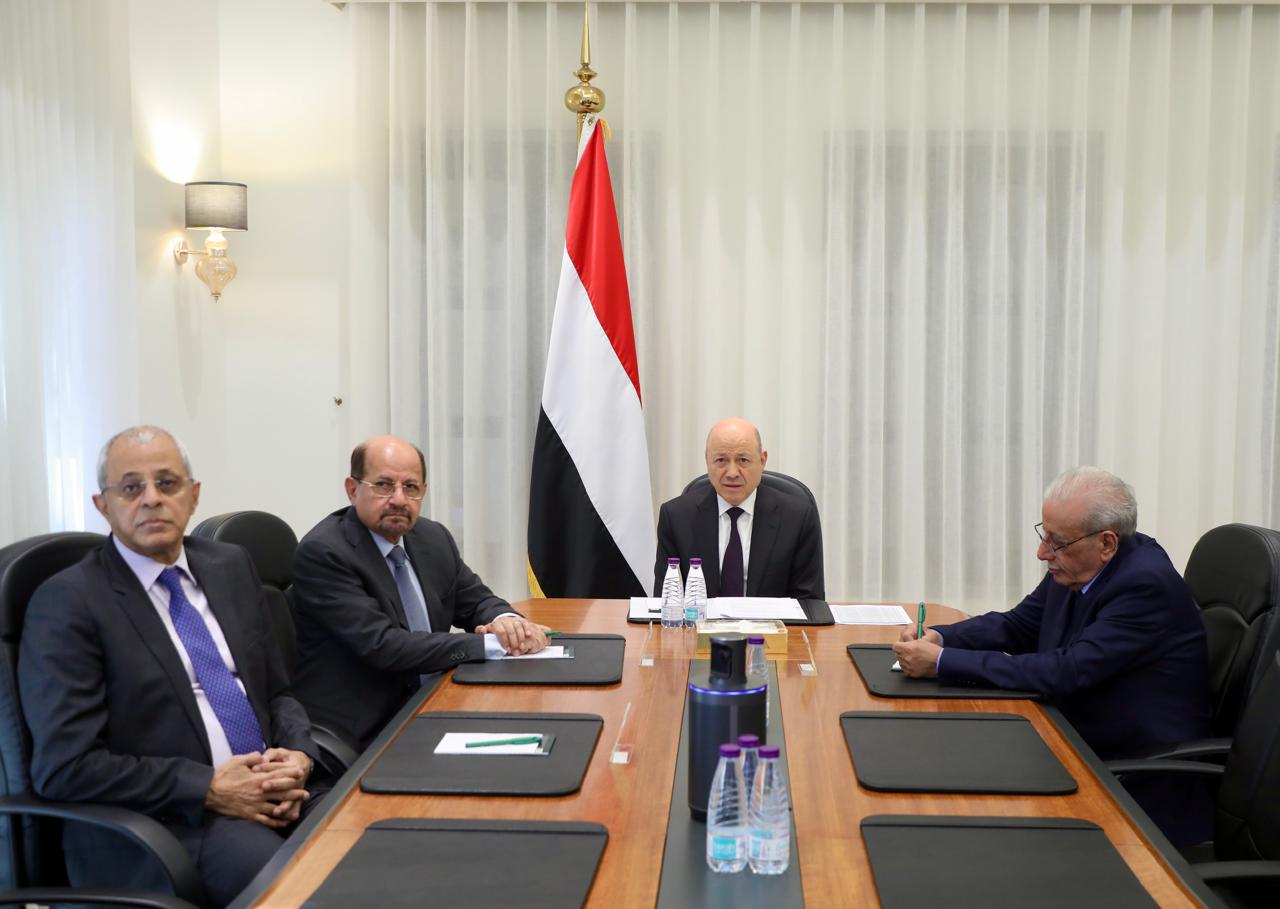
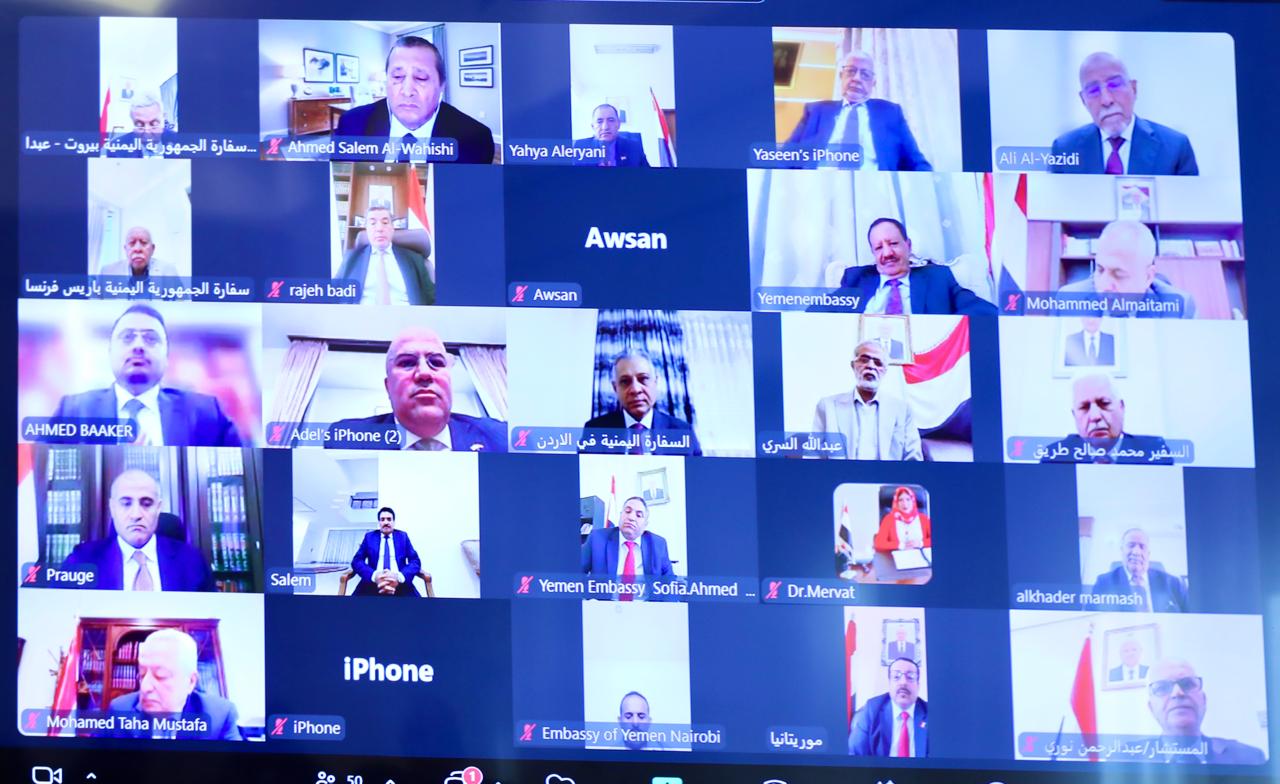
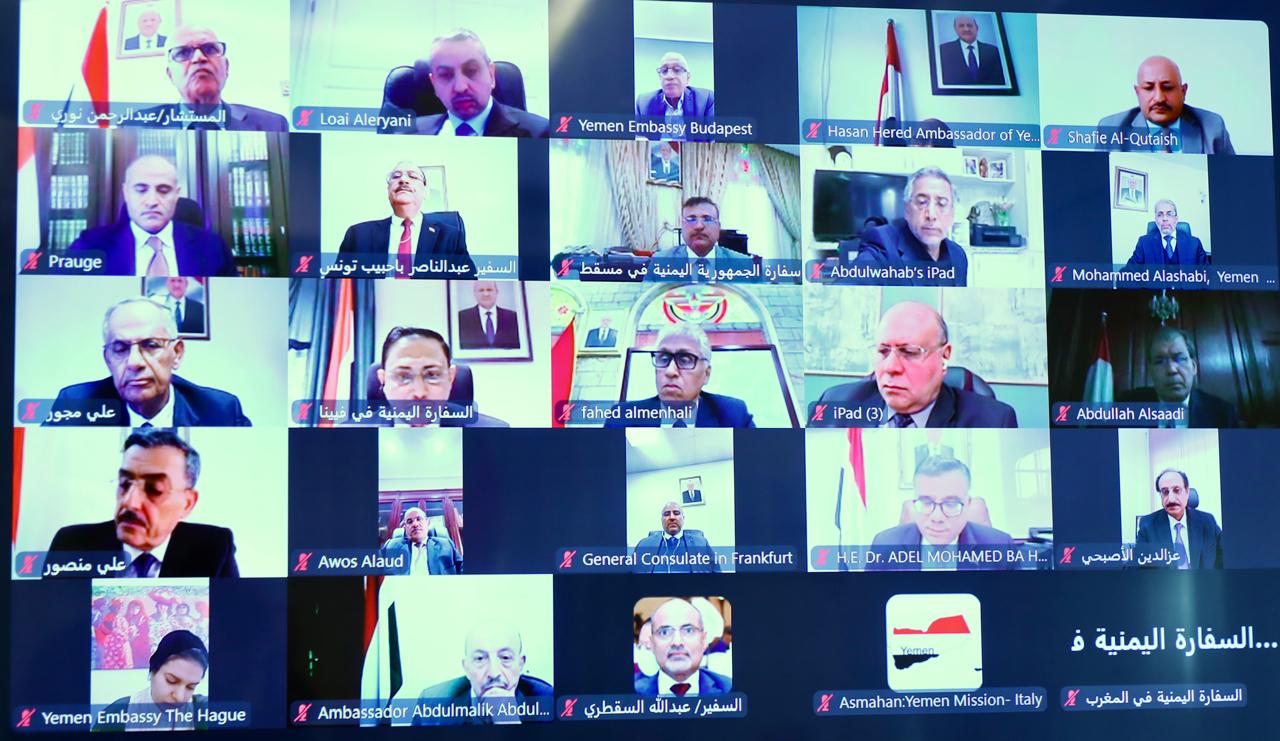
His Excellency Dr. Rashad Mohammed Al-Alimi, President of the Presidential Leadership Council, held a meeting, today Tuesday, with the leadership of the Ministry of Foreign Affairs and heads of Yemeni diplomatic missions abroad, in the presence of Dr. Shai’a Al-Zindani, Minister of Foreign Affairs and Expatriates.
During the meeting, President Al-Alimi expressed his appreciation, and that of his fellow members of the Presidential Leadership Council, for the efforts exerted by the Ministry of Foreign Affairs and its diplomatic missions in representing the Republic of Yemen and serving its citizens and national interests abroad.
The President briefed the leadership of the Ministry and heads of missions on recent domestic developments, foremost among them the unilateral measures recently taken by the Southern Transitional Council in Hadhramaut and Al-Mahra governorates. He noted that these measures reached a particularly dangerous stage this week by pushing state institutions and agencies to issue statements endorsing the division of the country and adopting high-level political positions beyond their mandate, thereby threatening the unity of decision-making and the legal status of the state.
President Al-Alimi warned of the grave risks of this trajectory, which aims to impose a fait accompli and create a parallel authority by force. He stressed that this obliges all parties, including the international community, to work to prevent the country from sliding into a new internal confrontation, the primary beneficiaries of which would be the Iran-backed Houthi militias, terrorist networks, and the chaos intertwined with them.
His Excellency reaffirmed that under no circumstances would it be acceptable for political partnership to turn into rebellion against the state or an attempt to impose realities by force. He emphasized that “sovereign political positions are determined by the Presidential Leadership Council and the competent state institutions, foremost among them the Ministry of Foreign Affairs within its mandate, not by any executive entity through statements or alignments.”
President clarified that the references governing the transitional phase are clear with regard to the existing consensus, foremost the Declaration on the Transfer of Power and the Riyadh Agreement. He noted that these references define the authorities responsible for representing the state, managing foreign policy, mechanisms for decision-making and affirm the protection of national unity and the integrity of the country’s territory.
He renewed his affirmation that the Southern cause is a just political and rights-based issue, and that the Presidential Leadership Council’s commitment to it remains firm in accordance with the agreed references and its negotiated framework within the comprehensive peace process.
In this context, President Al-Alimi pointed to the political and representative gains achieved for the Southern cause in recent years through the support of brothers and the prevailing national consensus. His Excellency warned that adventurism through unilateral measures threatens these gains and shifting the cause from a safe and fair resolution path to an uncalculated course of confrontation.
He further stressed that recent unilateral actions do not only threaten internal stability, but also affect the state’s reciprocal commitments to safeguarding the security of neighboring countries, as well as international efforts to protect maritime corridors, energy supplies, and commercial shipping in the Arabian Sea, the Red Sea, and the Gulf of Aden.
President Al-Alimi emphasized that Yemen’s supreme interests today lie in preserving the unity of decision-making, sustaining regional and international support for economic recovery, and preventing the fragmentation or weakening of the existing legitimate alliance.
He added that any duplication of authority or decision-making would hinder support programs and return Yemen to the square of a disputed, failed state.
The President explained that any division within the camp of legitimacy would provide the Houthis with an entry point for mobilization under false slogans, increase the fragility of liberated areas, disrupt regional and international partners, and open the door to wider escalation.
He also addressed the repercussions of such divisions on existing governmental partnerships with the international community in areas including coast guard operations, combating smuggling, maritime security, training, and capacity building, noting that these partnerships are based on a fundamental condition: the existence of one state with one decision.
President Al-Alimi warned that any duplication of decision-making or parallel authorities would create legal and political confusion for partners. Accordingly could lead to the suspension or reassessment of cooperation programs, as previously occurred with the International Monetary Fund.
He added that there are also direct humanitarian and economic repercussions, noting that the number of Yemenis in need for assistance this year has risen to nearly 20 million, at a time when the phase requires the highest level of cohesion to restore confidence and stability.
The President expressed his confidence in the government’s ability, through its experienced diplomatic leadership, to turn this crisis into an opportunity for strength by raising the state’s sovereign authority, consolidating unified state references, and establishing red lines against any unilateral action.
His Excellency directed the administrative fortification of state institutions by regulating official correspondence. He also stressed the need to prevent the politicization of sovereign and service ministries and institutions. In addition, he instructed the adoption of a clear legal course to address any violations that undermine the unity of decision-making or harm the state’s legal status.
President Al-Alimi underscored the need to refocus national efforts on the primary enemy represented by the overthrow of the coup staged by the Iran-backed Houthi terrorist militias, restoring state institutions, and ending humanitarian suffering.
The meeting was attended by Dr. Yahya Al-Shaeibi, Director of the Office of the Presidency, Mr. Mustafa Noman, Deputy Minister of Foreign Affairs and Expatriates, and Mr. Awsan Al-Oud, Undersecretary of the Ministry for Financial and Administrative Affairs.

PLC President: Decision to End Houthi Terrorism Is in Force and Irreversible
President Dr. Rashad Al-Alimi, President of the Presidential Leadership Council (PLC), affirmed that “Dawn of Yemen” Operation is proceeding toward its ultimate goal

PLC Warns Against Espionage and Cooperation with Houthis, Orders Pursuit of Those Involved
Tue ، 13 Oct 2026 05:51

PLC President Affirms Yemen’s Full Solidarity with Saudi Arabia, Vows to End Houthi Terrorism
Sat ، 10 Oct 2026 05:51

PLC President: “Dawn of Yemen” Operation to Continue Until All Its Objectives Are Achieved
Wed ، 07 Oct 2026 05:51