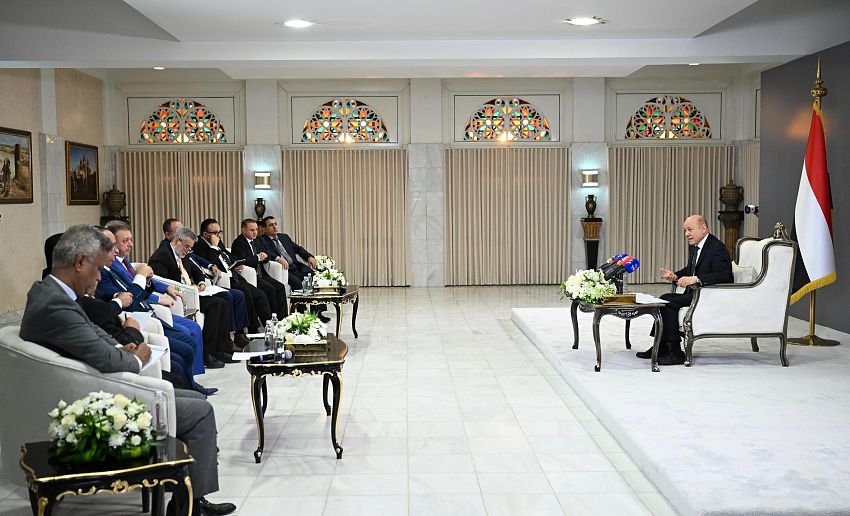
PLC President’s Final Message to Militias: You Still Have an Opportunity to Lay Down Arms and Help Build a Homeland for All
Aden
President Dr. Rashad Mohammed Al-Alimi, President of the Presidential Leadership Council (PLC) and Supreme Commander of the Armed Forces, affirmed that the Yemeni state is now more capable, cohesive, and prepared to protect its citizens, institutions, and sovereign interests. This follows years of efforts to unify political, military, security, and economic decision-making and rebuild state institutions. It also reflects a shift in the regional and international approach toward the terrorist Houthi militias.
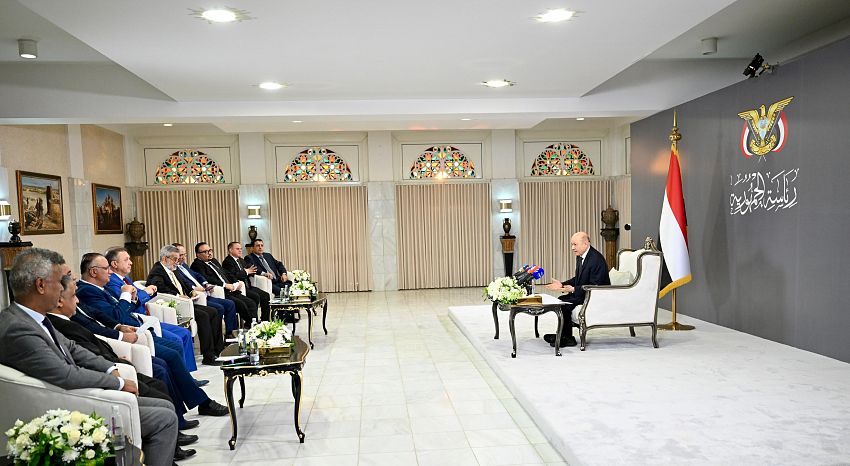
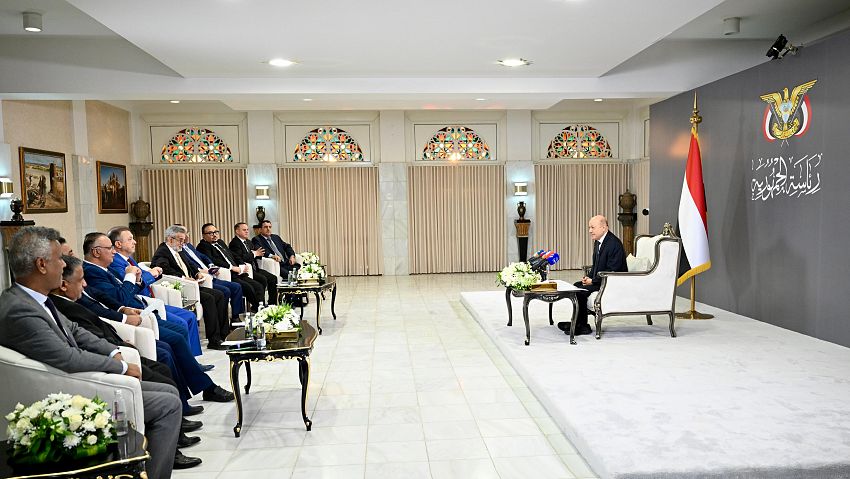
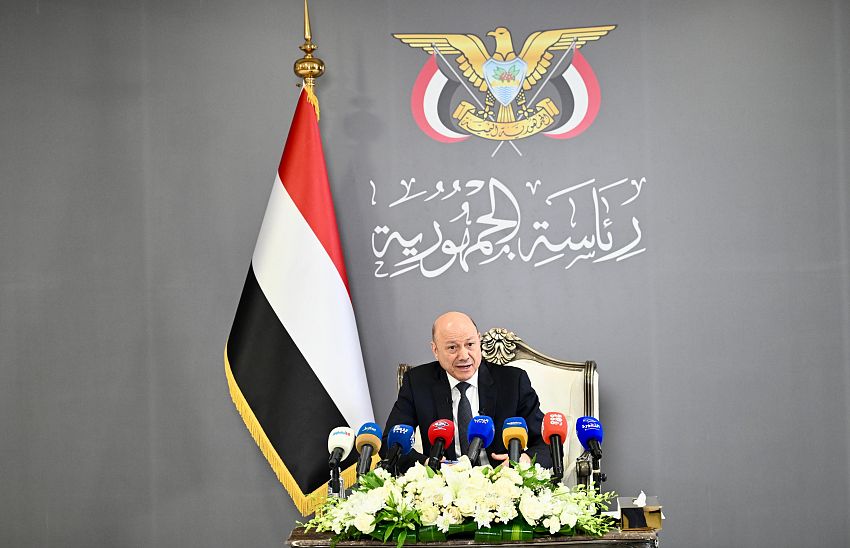
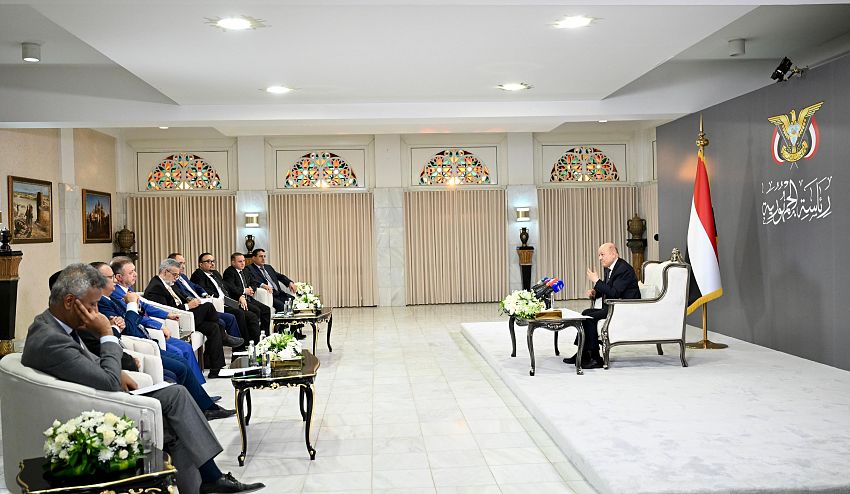
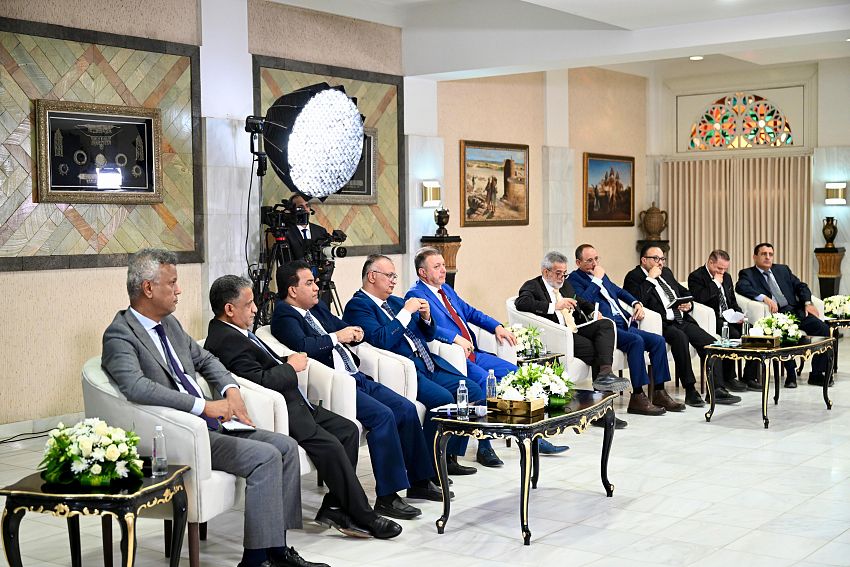
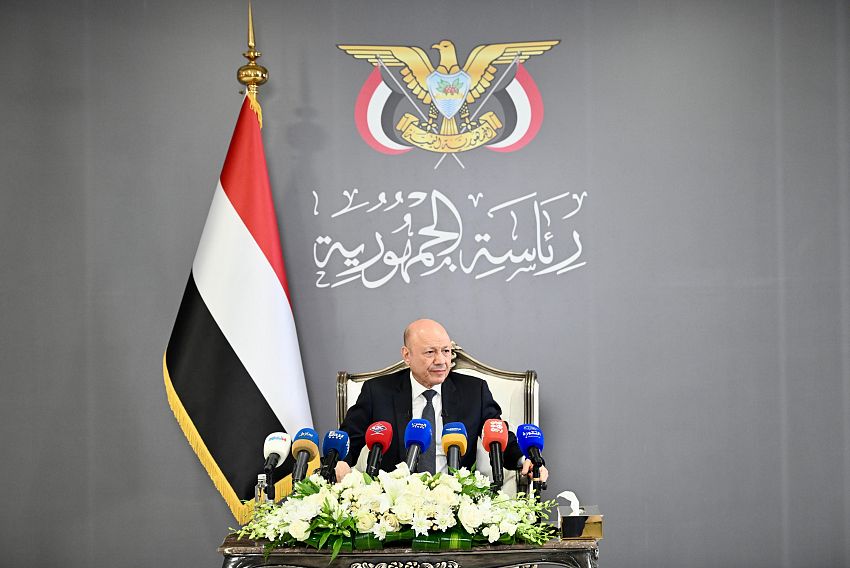
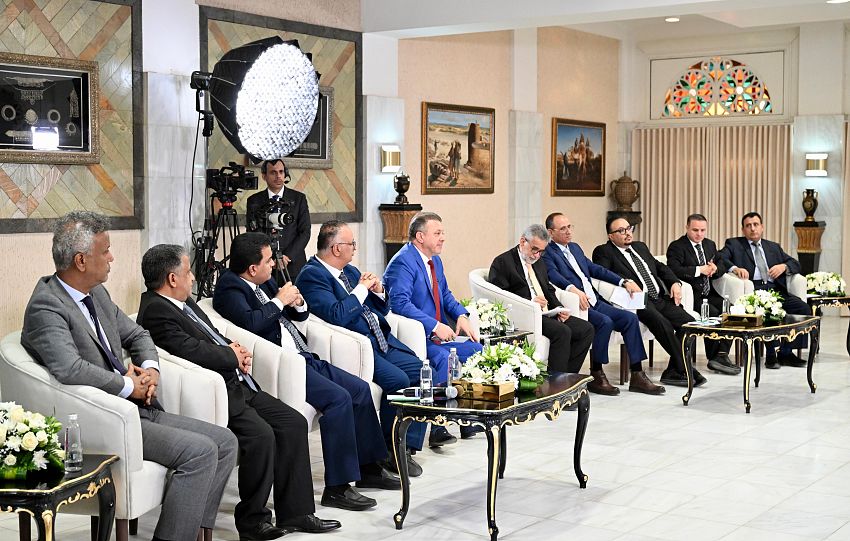
Speaking at an expanded meeting with leaders and representatives of official and local media institutions, the PLC President said that the state’s strategy is clear: to restore its institutions and end the coup. He stressed that the timing and steps for achieving this objective are a matter for the leadership, urging Yemenis to trust their state and its institutions.
President Al-Alimi stressed that the state’s position today is completely different from previous stages, citing greater internal unity, a cohesive political and military front, growing popular support, and a fundamental regional and international shift in understanding the nature of the Houthi threat.
In this context, he said that from now on, there would be no Houthi militia action without a response or comprehensive deterrence.
President Al-Alimi affirmed that “the situation has changed,” saying: “We have armed forces operating under a single operations room, the Supreme Commander of the Armed Forces, and the Higher Military Committee. This force is ready to perform its role in defending Yemenis, their facilities, and national institutions. Our strategic objective is to restore state institutions and end the coup.”
His Excellency explained that the experience of the past decade with the Houthi militias had consistently demonstrated that, for them, a truce represents a period for rebuilding their military capabilities and preparing to resume the war. He stressed that the government is now fully aware that these militias are a project of war and destruction, not a project of peace.
The PLC President placed the experience of the past four years within the broader context of the transition from a state exhausted by war, divisions, and declining resources to institutions gradually regaining their capacity to function. He explained that the strategic objective behind establishing the PLC was to unify the political and military components for confronting the Houthi militias, ending the coup, and restoring state institutions.
He added that substantial efforts had been made during this period to unify political, security, military, and economic decision-making. He stressed that the armed forces now operate within a unified command and operations structure and are ready to defend Yemenis, their facilities, and national institutions.
He said the government is not in favor of another truce that merely reproduces previous experiences. Rather, it seeks a lasting and sustainable peace based on a state that holds the monopoly over arms and sovereignty and a constitution that applies to all. It also seeks full equality among citizens and institutions whose officials serve the people rather than rule over them.
President Al-Alimi explained that one of the most important changes over the past four years has been the international community’s changing perception of the Yemeni crisis. For years, developments were viewed through a narrative that treated the situation as a political dispute that could be contained by accommodating the Houthi militias through incentives and traditional settlements.
He said the state acted responsibly during the truce and made many concessions under intense international pressure. However, the militias’ conduct, including attacks on oil facilities, international shipping, and regional security, dispelled the illusions that they could become a partner for peace.
He noted that the international question is no longer, “How can we accommodate the Houthis?”. But rather, “How can we protect the Yemeni state and safeguard the region, waterways, and international peace and security?”
The President pointed out that the government had waged a political and diplomatic campaign over the past years to correct the narrative surrounding Yemen and clarify the militias’ links to the Iranian project and its cross-border threat.
He described the United States’ designation of the Houthi militias as a terrorist organization, the inclusion of dozens of entities and individuals linked to their financial and oil networks on sanctions lists, and recent international positions as indicators of a fundamental shift in favor of the state and the Yemeni cause.
He affirmed that efforts would continue to expand the international designation of the militias, including at the European Union level. In this regard, he praised the role played by the Kingdom of Saudi Arabia in supporting Yemen’s position across various regional and international forums. He highlighted its political and diplomatic weight in supporting the issuance of the latest Security Council stances and maintaining international unity on the Yemeni issue.
On the economic front, President Al-Alimi affirmed that the resumption of oil exports is a sovereign decision par excellence. He affirmed that Yemen’s resources must benefit all Yemenis and be used to pay salaries, provide services, and improve living conditions.
He explained that the Houthi militias’ targeting of oil facilities in October 2022 deprived the government of around 70 percent of its revenues, while the damage caused by those attacks exceeded $40 million. Meanwhile, the state continued repairing the facilities and preparing for the resumption of exports.
He said the government is working in parallel to increase non-oil revenues and restore oil and gas exports. He noted that some revenues had increased by as much as 100 percent compared with the same period last year.
He expressed hope that by the end of the year, the government would be able to cover its public-sector salary bill from domestic revenues. He reaffirmed the state’s commitment to paying the salaries of civil employees in areas under Houthi control based on the 2014 payroll records once exports resume and the necessary resources are secured.
He noted that the Balhaf gas project, the largest foreign investment project in Yemen’s history, represents one of the strategic resources capable of supporting economic recovery. Restoring its operations and resuming gas exports, he said, would provide an important opportunity to stabilize conditions and improve Yemenis’ livelihoods.
The PLC President reviewed a number of economic and institutional reforms implemented by the state, foremost among them regulating and financing imports, increasing revenues, activating the Supreme Tender Committee, making changes within revenue-generating institutions, and strengthening governance, transparency, and oversight of public funds. He stressed that combating corruption, terrorism, terrorist financing, and smuggling that supports the militias must proceed along a single track.
President Al-Alimi revealed wide-ranging measures to combat smuggling networks, including the closure of routes used to smuggle weapons, drugs, and terrorist elements, and the deployment of forces along a line extending more than 250 to 300 kilometers to cut smuggling routes leading toward areas under militia control.
He said the armed forces had succeeded in cutting key arteries used to smuggle weapons and drugs and in uncovering hideouts, explosives, and improvised explosive devices linked to the Houthi militias and Al-Qaeda. He noted that the attack on forces in the Al-Abr area came as part of an attempt by the militias to reopen these routes.
He also pointed to the security agencies’ success in apprehending dozens of Houthi and terrorist cells in the liberated governorates and thwarting assassination plots. He described this as one of the fruits of rebuilding state institutions and security agencies.
President Al-Alimi affirmed that the most important development on the military front is the unity and integration of the various fronts. He noted that Marib is no longer standing alone in confronting the militias, adding that recent attacks have triggered simultaneous responses from the fronts in Taiz, Shabwa, Al-Dhalea, Lahj, Hajjah, Saada, and elsewhere.
President Al-Alimi described Marib Governorate as the “citadel of the Republic,” which stood against the coup from the outset, noting that its targeting is linked to its national stance and economic and strategic importance.
On the southern issue, President Al-Alimi renewed his affirmation that the southern issue is a legitimate political cause arising from grievances and imbalances accumulated over decades. He stressed that restoring state institutions does not mean returning to the pre-war situation or reproducing previous centralization and practices.
He referred to measures taken by the state to address the repercussions of the 1994 summer war, including reinstating more than 36,000 people who had been dismissed from their jobs and granting them their entitlements and ranks.
He stressed the need to establish a political framework for addressing the southern issue through the South-South dialogue hosted by the Kingdom of Saudi Arabia at his request. He said the PLC and government would remain committed to the outcomes agreed upon by the southern components for settling this legitimate issue within the framework of a comprehensive solution.
He stressed that there is no contradiction between restoring the state and resolving the southern issue. He added that the continuation of the Houthi coup and war obstructs efforts to reach a sustainable solution to the issue.
Speaking about Hadhramout, President Al-Alimi said that Hadhramout is not merely an oil well, but rather a history, society, culture, economic and human weight, and strategic location. He affirmed the state’s commitment to the governorate’s right to its share of oil revenues.
At the same time, he stressed the need to subject local resources to the principles of governance, transparency, and oversight and ensure that they are directed toward development projects and services.
He said the state would continue to view Hadhramout as a driver of development, financial and administrative decentralization, and a model for local governance, investment, and social coexistence. He pointed to strategic projects under consideration, including the port of Brom and electricity and energy projects.
President Al-Alimi affirmed that security conditions in Aden and the southern governorates had improved significantly, citing the security agencies’ success in pursuing cells and wanted individuals and thwarting terrorist and assassination plots.
At the same time, President Al-Alimi said the state is not satisfied with the current level of services and economic conditions. However, he praised the government’s work from the interim capital, Aden, under what he described as difficult, complex, and unprecedented circumstances. He called for support for the government of Prime Minister Dr. Shai’a Al-Zindani and its ministers and for enabling them to carry out their duties.
At the conclusion of the meeting, the PLC President delivered a series of messages to Yemenis, the armed forces, brothers and allies, the international community, and the Houthi militias.
Addressing Yemenis, he said: “Do not lose confidence in the state.” He noted that Yemen had endured war, a coup, terrorism, economic collapse, displacement, division, and homelessness, yet the state remained and Yemenis remained capable of protecting their national project.
He added that the state does not deny its mistakes or shortcomings, but has preserved the national alliance and prevented disputes among partners of the state and republic from returning to armed conflict. He said the national front is now more cohesive than ever.
He delivered a special message to citizens in areas under Houthi militia control. He stressed that they are not adversaries of the state and that the battle is not against any region, tribe, or party, but rather for a citizen who receives his salary, education, and services without being subjected to levies imposed to finance wars.
“We want all of us to enter together as victors for the state, victors for the Republic and the rule of law,” he said.
He also addressed the armed forces, security forces, resistance, and tribes, stressing that the blood of the martyrs is not merely a number but a trust borne by the state leadership. He called on the forces to uphold the ethics of the state, protect civilians, respect the law, and prevent revenge, regionalism, and vendettas.
“Our strength is not only in weapons; strength lies in the values we uphold and in the state whose institutions we seek to restore,” he said.
President Al-Alimi expressed his appreciation for the stances of his brother, Custodian of the Two Holy Mosques King Salman bin Abdulaziz Al Saud, and His Royal Highness Prince Mohammed bin Salman bin Abdulaziz, Crown Prince and Prime Minister. He commended the support the Kingdom has provided to Yemen politically, economically, and humanitarianly at various levels.
He affirmed that the Kingdom of Saudi Arabia is, for Yemen, “not a donor or an ordinary ally, but a partner in neighborhood, destiny, and a shared future.”
He also expressed his gratitude to the Gulf Cooperation Council states, Egypt, Jordan, Türkiye, and other countries that have hosted millions of Yemenis, including families, students, patients, workers, and businessmen. He expressed hope that Yemenis would return to a safe homeland, bringing with them the education, knowledge, and experience they had acquired to contribute to building its future.
The President called on the international community to help Yemenis end the war rather than manage it indefinitely. He stressed that the policy of containing the militias, offering incentives, and betting on their transformation into a peace partner had failed.
He stressed that sustainable peace cannot be based on sharing sovereignty between a state and militias, and that the state alone must hold the monopoly over sovereignty and force.
In his final message to the Houthi militias, the PLC President said that the opportunity remains available for them to lay down their arms, engage in political life, and compete through the ballot box with the same rights as other Yemenis. He affirmed that Yemen has room for everyone under the umbrella of the state and the law.
President Al-Alimi concluded his remarks with a message to state institutions. He said they must be worthy of Yemenis’ patience, work harder, make fewer mistakes, hold negligent officials accountable, and give citizens an additional reason every day to have confidence in the state.

PLC President Discusses National and Regional Developments with British Foreign Secretary
His Excellency President Dr. Rashad Al-Alimi, President of the Presidential Leadership Council (PLC), discussed today, Friday, with British Secretary of State for Foreign, Commonwealth and Development Affairs, Ed Miliband the latest developments


PLC President: Decision to End Houthi Terrorism Is in Force and Irreversible
Tue ، 13 Oct 2026 03:37

PLC Warns Against Espionage and Cooperation with Houthis, Orders Pursuit of Those Involved
Tue ، 13 Oct 2026 03:37