PLC President: Targeting Mocha Port Exposes Militias’ Systematic War on Yemenis’ Resources and Lifelines
Riyadh
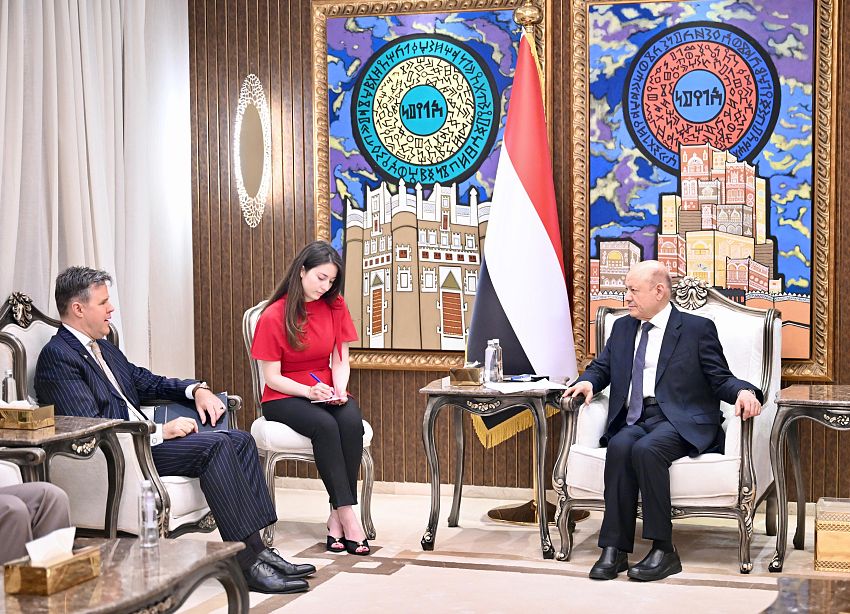
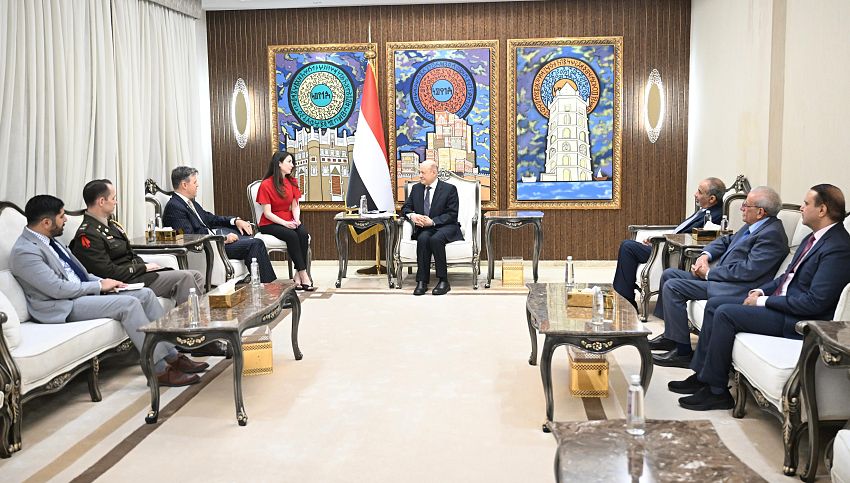
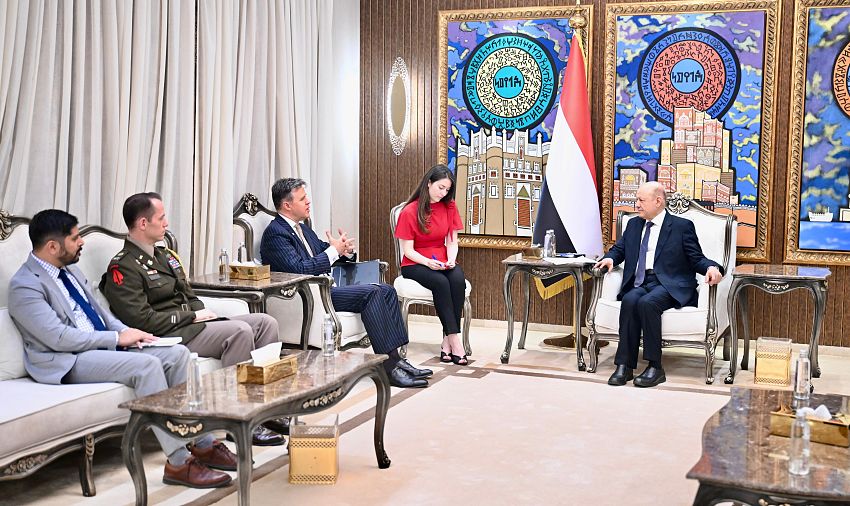
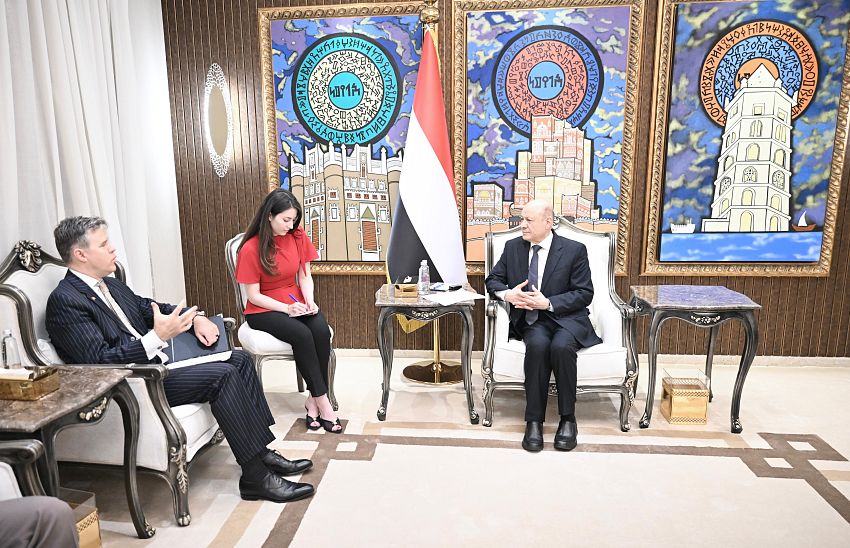
His Excellency President Dr. Rashad Mohammed Al-Alimi, President of the Presidential Leadership Council (PLC), received today, Sunday, the Chargé d’Affaires of the United States Embassy in Yemen, Neil Hop. The meeting discussed the distinguished bilateral relations between the two friendly countries and prospects for strengthening and developing them at all levels.
The PLC President welcomed the new U.S. Chargé d’Affaires and affirmed that all necessary facilities and support would be provided to enable him to carry out his diplomatic duties and strengthen the relations of friendship and partnership between the two countries.
President Al-Alimi expressed his high appreciation for the U.S. role in supporting the Yemeni government, protecting regional security, safeguarding freedom of international navigation, and combating terrorism. He affirmed his aspiration for a more advanced phase of partnership between the two friendly countries.
The President briefed the U.S. Chargé d’Affaires on the rapidly unfolding developments on the ground. These included the Houthi terrorist missile and drone attack earlier today that targeted Mocha Port on the western coast of Taiz Governorate. The attack represents a new escalation targeting one of the Yemeni people’s vital ports.
President Al-Alimi said the targeting of Mocha Port, following days of attacks on Armed Forces positions, displacement camps and civilian sites, as well as attempts to target ships and national facilities, confirms that the Houthi militias are pursuing a systematic war against the Yemeni people’s resources, lifelines and economic gateways.
He added that the Houthi militias, which claim that areas under their control are being subjected to a blockade, are themselves targeting ports, airports and economic facilities. They are also threatening commercial shipping and food and fuel supplies in an attempt to strangle the Yemeni people and undermine their means of dignified livelihood, thereby exacerbating their humanitarian suffering.
The PLC President affirmed that the targeting of a vital seaport near Bab al-Mandab is an extension of Iran’s escalation policy, which targets economic facilities, maritime routes and the interests of countries in the region. He said the attack once again demonstrates the danger of leaving missile and drone capabilities and other advanced weapons outside the authority of the state.
President Al-Alimi stressed that this escalation places the international community, foremost among it the United States, before a clear responsibility to protect Yemenis’ right to safe access to their ports, airports and vital facilities. He called for moving beyond merely containing the Houthi threat to addressing its sources and means, while supporting Yemeni state institutions and their ability to protect the country’s territory, waters and citizens’ interests.
The PLC President explained that developments in the region once again confirm that the problem does not lie in separate crises. Rather, it stems from a single source of instability based on the use of armed groups outside state institutions to pursue cross-border objectives.
President Al-Alimi renewed his support for any diplomatic effort aimed at easing tensions and preventing wars in the region. However, he warned that any understandings that fail to address, clearly and sustainably, the threat posed by Iranian-backed militias, their military capabilities, funding and threats to regional countries will only postpone the crisis rather than resolve it.
He stressed that sustainable security cannot be established in the region while armed groups remain capable of making decisions on war, launching missiles and drones, and threatening international waterways independently of state institutions and sovereignty.
The President said that peace and deterrence are not contradictory options. He noted that successful diplomacy requires an environment that prevents rogue actors from believing that escalation can bring them illegitimate gains.
President Al-Alimi pointed out that recent developments underscore the danger of armed groups continuing to possess cross-border capabilities. He stressed that protecting civilian and economic facilities and maritime routes is a shared regional and international responsibility.
The President recalled that the Yemeni government has made major concessions over many years to alleviate the suffering of citizens. Meanwhile, the militias have continued to develop their military capabilities, threaten cities and maritime routes, undermine state institutions, and increasingly tie Yemen to the Iranian regime’s agenda. He affirmed that this group does not view peace as an end in itself, but rather as an opportunity to reposition itself.
He stressed that the Houthis should not be granted incentives through blackmail after they failed to achieve their objectives by force. He said that any regional understandings must ultimately lead to sovereign national states that exclusively control the legitimate instruments of force, alongside constitutional institutions representing all their citizens.
President Al-Alimi said recent developments on the ground have demonstrated that state institutions and the Armed Forces have become more capable, cohesive and coordinated. He stressed that continued attacks will not come without political and military costs.
The PLC President urged the United States and the international community to move from a policy of managing the Houthi threat to addressing its causes and sources of strength. This should be done through sustained political, economic and diplomatic pressure on the militias and their supporters, while strengthening the capabilities of the government and state institutions to protect the country’s territory, waters and citizens’ interests.
He said that the stronger the Yemeni state becomes, the less capable Iran and extremist groups will be of using Yemen as a platform to threaten the region and the world.
The meeting was attended by Dr. Yahya Al-Shuaibi, Director of the Office of the Presidency of the Republic.

PLC President Calls for General Mobilization, Opens Door for Safe Return of Those Misled by Houthis
President Dr. Rashad Al-Alimi, President of the Presidential Leadership Council (PLC), called on the Yemeni people to engage in general mobilization

President Al-Alimi Holds Phone Call with President Abdel Fattah Al-Sisi
Fri ، 25 Sep 2026 01:26

PLC President: Armed Forces Capable of Regaining Initiative and Ending Houthi Threat
Thu ، 24 Sep 2026 01:26

President Al-Alimi Receives Reply Letter from Emir of Kuwait
Tue ، 22 Sep 2026 01:26