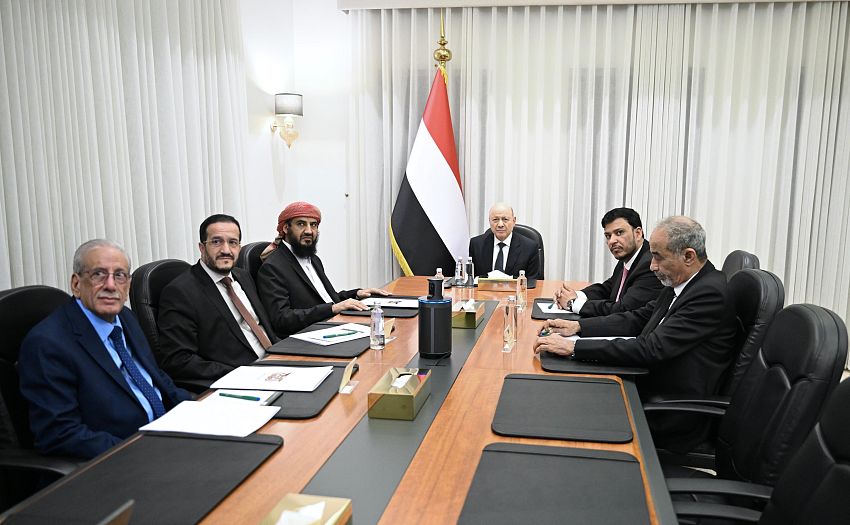
PLC Hails Institutional Cohesion and the Growing Capabilities of State Institutions to Deter Militia Threats
Riyadh
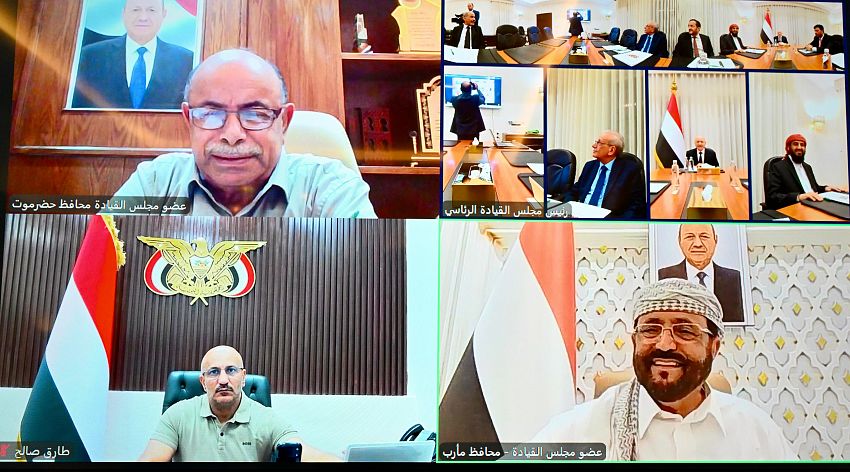
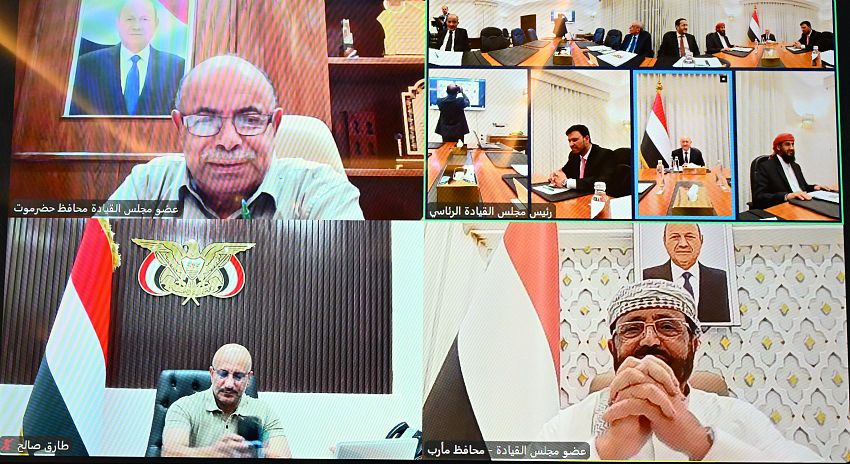
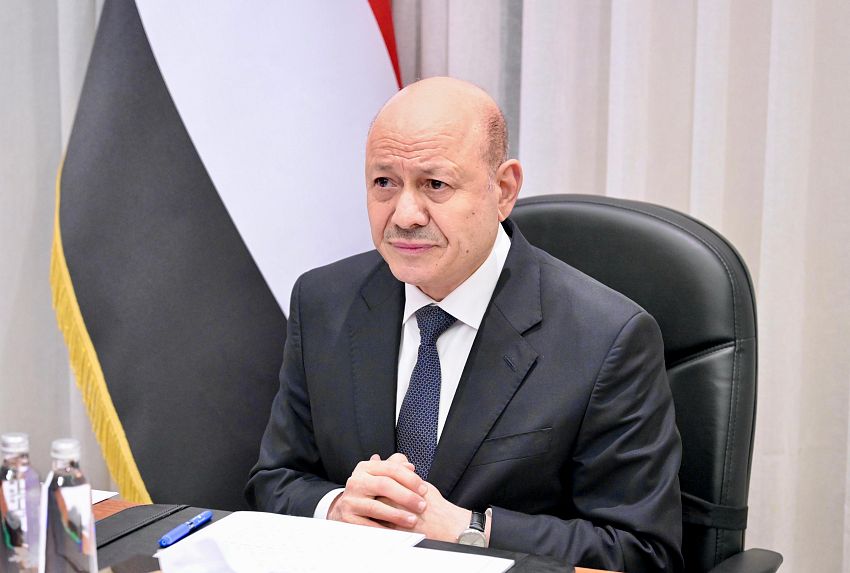
The Presidential Leadership Council (PLC) held an extraordinary meeting today, Tuesday, chaired by President Dr. Rashad Mohammed Al-Alimi, President of the Council. The meeting was attended by all Council members: Sultan Al-Arada, Tariq Saleh, Abdulrahman Al-Mahrami, Dr. Abdullah Al-Alimi, Othman Mujli, Mahmoud Al-Subaihi, and Salem Al-Khanbashi, to discuss the latest national and regional developments at all levels.
The Council reviewed briefing reports on the latest security and military developments across various fronts, the operational readiness of the armed forces and security agencies, and progress in implementing economic and financial reforms. It also reviewed the government’s efforts to improve public services, strengthen economic stability, and alleviate the humanitarian suffering caused by the Iran-backed Houthi terrorist militias.
The PLC affirmed that the cohesion of the Council and the government now represents one of the key pillars of the transitional period, enabling them to move forward in fulfilling their national responsibilities in a spirit of teamwork. It said this cohesion would strengthen citizens’ confidence in state institutions, demonstrate their ability to address evolving challenges with institutional responsibility and unity of decision-making. It added, this cohesion would advance the implementation of the national obligations set out in the Declaration of the Transfer of Power.
The Council commended the wise leadership of President Dr. Rashad Mohammed Al-Alimi in steering the country through its exceptional circumstances. It praised his political acumen and his ability to unify positions, preserve the cohesion of state institutions, and address mounting challenges with a strong sense of national responsibility. It also commended his success in transforming many challenges into opportunities and consolidating partnerships with regional and international partners. The Council further praised his efforts to mobilize regional and international support for the battle to restore state institutions and end the coup.
The Council also praised the strong sense of patriotism demonstrated by its members, their shared responsibility and partnership in managing this critical phase, and their commitment to institutional governance, prioritizing the country’s supreme interests, and addressing national issues through consensus. It said these efforts had reinforced the Council’s unity and cohesion and strengthened the confidence of citizens and regional and international partners in its ability to lead the transitional period and fulfill its national obligations.
The PLC expressed appreciation for the efforts of the government led by Prime Minister Dr. Shaya Al-Zandani and its commitment to implementing economic and administrative reforms. It stressed the need to intensify efforts to improve public services, enhance state revenues, and preserve fiscal and monetary stability in ways that positively impact citizens’ lives and strengthen the state’s ability to meet its essential obligations.
The Council also praised the high level of readiness of the armed forces, security agencies, and all military formations, as well as their achievements in safeguarding national sovereignty, deterring terrorist threats, and enhancing security and stability. It emphasized that the progress made in unifying military and security decision-making constitutes a solid foundation for completing the development of a professional national military institution whose loyalty is solely to the Constitution and the state.
The PLC reviewed the criminal attack carried out by the Houthi terrorist militias against an Indian civilian cargo ship while it was sailing in the Red Sea, causing it to sink completely. The Council held the terrorist militias fully responsible for the serious criminal act, describing it as a continuation of their longstanding pattern of targeting civilian objects, economic facilities, commercial vessels, and international shipping lanes in service of the interests of their backers in the Iranian regime.
The Council commended the swift response of the Coast Guard and naval forces, which demonstrated a high level of professionalism in rescuing all members of the ship’s crew. It said the successful operation reflected the growing capabilities of national institutions to protect maritime routes and respond effectively to maritime emergencies.
The PLC stressed that the attack formed part of a long series of crimes committed by the Houthi militias against the Yemeni people. These crimes have ranged from attacks on and sieges of cities to strikes on airports and oil facilities, the disruption of the country’s exports, and the exposure of Yemeni ports to the risk of closure. It warned that such actions would deepen the humanitarian crisis and deprive millions of Yemenis of their sources of income, livelihoods, essential services, and life-saving goods.
The Council called on the international community, the United Nations Security Council, and relevant maritime organizations to take deterrent measures to halt these repeated terrorist attacks and hold their perpetrators and supporters accountable. It said such measures are essential to safeguard international shipping lanes and protect freedom of navigation. The Council also stressed the need to prevent the Red Sea and the Bab Al-Mandab Strait from becoming a theater of blackmail threatening international trade and global energy supplies.
In this context, the PLC renewed its welcome for the announcement of the establishment of the multinational defensive maritime coalition led by the Kingdom of Saudi Arabia. It said the initiative represents an important strategic response to the growing challenges facing the security of the Red Sea, the Gulf of Aden, and the Bab Al-Mandab Strait. The initiative also reflects an advanced understanding that protecting international maritime routes is a shared responsibility requiring the highest levels of coordination and cooperation among brotherly and friendly countries.
The Council expressed its deep appreciation for the pivotal role played by the Kingdom of Saudi Arabia, under the leadership of the Custodian of the Two Holy Mosques King Salman bin Abdulaziz Al Saud and His Royal Highness Crown Prince Mohammed bin Salman bin Abdulaziz, in supporting the Yemeni people, protecting Yemen’s national institutions, and promoting regional security and stability. It affirmed that relations between the two brotherly countries continue to advance toward a promising and firmly established strategic partnership based on shared interests and a common destiny.
The meeting was attended by Dr. Yahya Al-Shuaibi, Director of the Office of the Presidency of the Republic.

PLC President Calls for General Mobilization, Opens Door for Safe Return of Those Misled by Houthis
President Dr. Rashad Al-Alimi, President of the Presidential Leadership Council (PLC), called on the Yemeni people to engage in general mobilization

President Al-Alimi Holds Phone Call with President Abdel Fattah Al-Sisi
Fri ، 25 Sep 2026 01:24

PLC President: Armed Forces Capable of Regaining Initiative and Ending Houthi Threat
Thu ، 24 Sep 2026 01:24

President Al-Alimi Receives Reply Letter from Emir of Kuwait
Tue ، 22 Sep 2026 01:24