President Al-Alimi: Stability of Southern Governorates a Model for Promising Yemeni–Saudi Partnership
Riyadh
His Excellency Dr. Rashad Mohammed Al-Alimi, President of the Presidential Leadership Council, affirmed that disciplined political pluralism constitutes the fundamental safeguard against the monopolization of power or a relapse into pre-state models. He stressed that it lays the foundations for national partnership and good neighborliness, away from exclusion, marginalization, and the demonization of others.
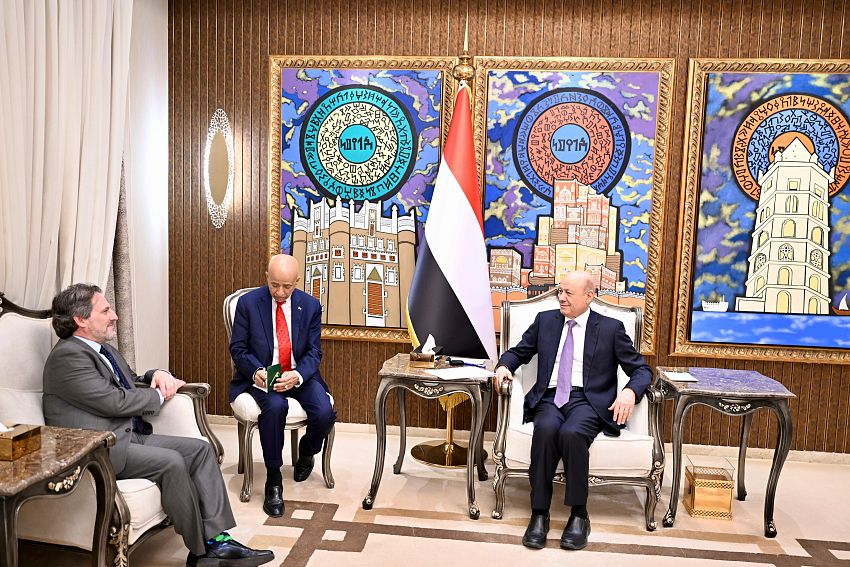
During a meeting on Wednesday with a delegation from the National Democratic Institute (NDI), headed by its Regional Director for the Middle East and North Africa, Jeffrey England, President Al-Alimi stated that the war waged by the Houthi militias has resulted not only in a crisis of authority but also in the collapse of state institutions that guarantee the political process.
He considered the central challenge today to be the reconstruction of the political sphere, so that competition shifts from weapons and closed ideologies to national programs centered on people, their service, and their advancement.
The President affirmed that the Council is currently working to reactivate state institutions domestically, ensure the regular functioning of the government from the interim capital, Aden, and proceed with measures to unify security and military decision-making under the Ministries of Defense and Interior. He underscored that any future political process must be based on the state’s monopoly over arms, an independent judiciary, and a new constitutional project that accommodates all developments and guarantees justice, the rule of law, and non-exclusion.
His Excellency noted that any political process must be preceded or accompanied by the disarmament of uncontrolled weapons, the dismantling of parallel military structures, and the criminalization of racist, dynastic, and regionalist ideologies in the constitution and law.
“Simply put, it is impossible to build a pluralistic democratic system in the presence of a fascist ideology that claims a divine right to rule people,” he said.
President Al-Alimi stressed that sustainable peace cannot be founded on power-sharing with armed militias. He warned that any truce that fails to address the roots of the armed Imamate project would remain a temporary ceasefire liable to collapse.
He also addressed ongoing arrangements to convene a Southern Dialogue Conference under the auspices of the brotherly Saudi Arabia, reiterating the state leadership’s full awareness and recognition of the just Southern cause and its commitment to a fair resolution. He said the process would begin with addressing grievances through an institutional legal track that guarantees non-recurrence.
The President expressed confidence in the wisdom of Southern forces to pursue an organized and responsible dialogue that prioritizes the public interest, unifies visions, prevents monopolization of representation, and integrates outcomes into a comprehensive national track.
He emphasized that the engineering of political processes should not overlook the interests and available opportunities for the Yemeni people in light of new developments, foremost among them the promising partnership with Saudi Arabia and its decisive support in protecting civilians and preventing the collapse of state institutions. He noted that the southern governorates could become a model for stable development and security partnership at all levels, as Yemen’s stability is part of regional security and not merely an internal matter.
“For this reason, these long-awaited gains on the path toward restoring state institutions and integrating into the Gulf system must not be squandered under any circumstances,” he added.
President Al-Alimi commended the role played by the National Democratic Institute in recent years in supporting political dialogue, empowering political parties, and enhancing the participation of women and youth, leading to the formation of the National Coalition of Political Parties and Components. He expressed his high appreciation for the Institute’s continued presence alongside the Yemeni people and its political engagement during the most challenging stages.
He affirmed that democratic institutions in Yemen have proven to be not merely decorative, but a fundamental pillar in efforts to restore the state and prevent the return of authoritarianism in its various forms.
The President also expressed his aspiration for further support in building the capacities of political parties and empowering youth and women during the transitional phase, in addition to providing advisory support in drafting a new constitution and complementary legal and electoral reforms. He emphasized that this unjust war will not continue indefinitely, as the will of the Yemeni people is capable of achieving victory even under the darkest circumstances, which necessitates preparation for the post-war phase and the realization of the desired peace.
The meeting was attended by Dr. Yahya Al-Shuaibi, the Director of the Office of the Presidency.

PLC President: Decision to End Houthi Terrorism Is in Force and Irreversible
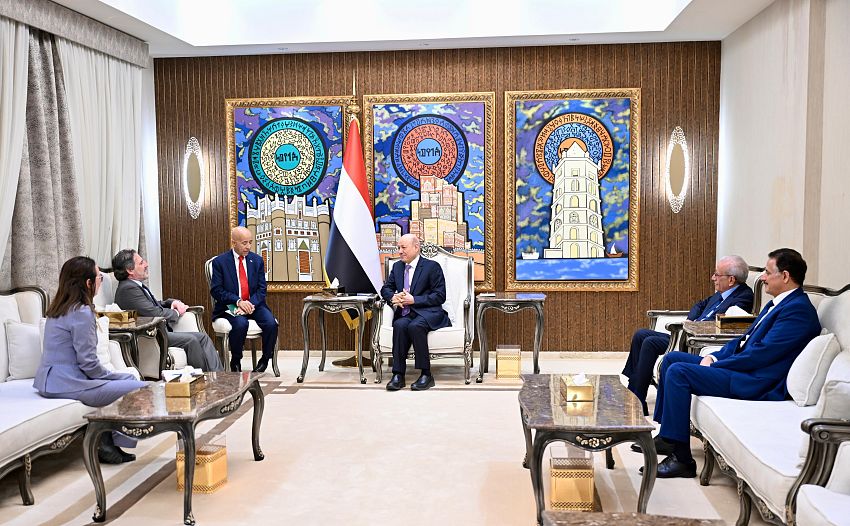
President Dr. Rashad Al-Alimi, President of the Presidential Leadership Council (PLC), affirmed that “Dawn of Yemen” Operation is proceeding toward its ultimate goal

PLC Warns Against Espionage and Cooperation with Houthis, Orders Pursuit of Those Involved
Tue ، 13 Oct 2026 05:00

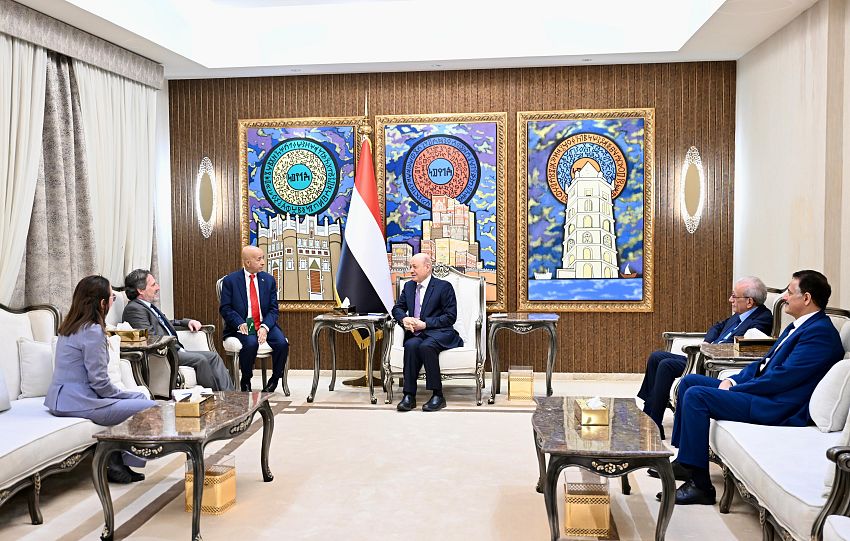
PLC President Affirms Yemen’s Full Solidarity with Saudi Arabia, Vows to End Houthi Terrorism
Sat ، 10 Oct 2026 05:00

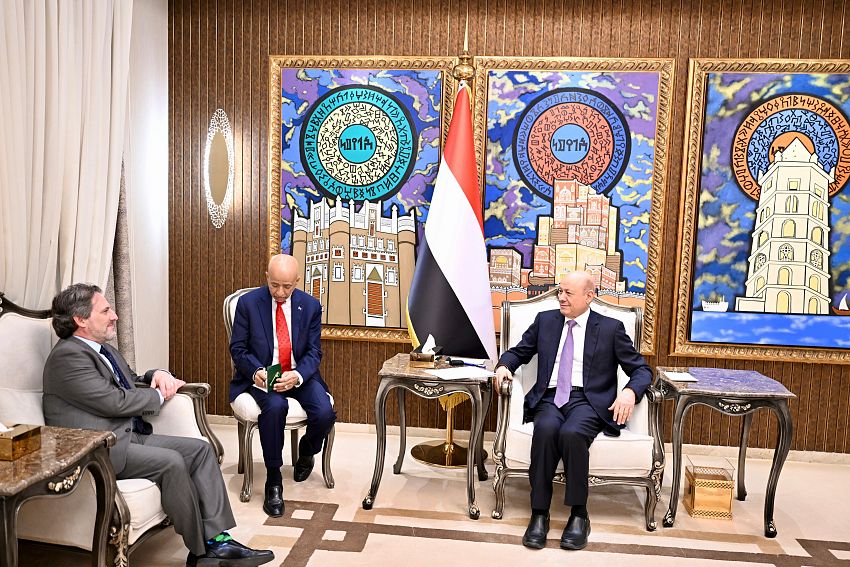
PLC President: “Dawn of Yemen” Operation to Continue Until All Its Objectives Are Achieved
Wed ، 07 Oct 2026 05:00