PLC President: Holding Perpetrators of Grave Rights Violations Accountable Integral to Restoring State Institutions
Riyadh
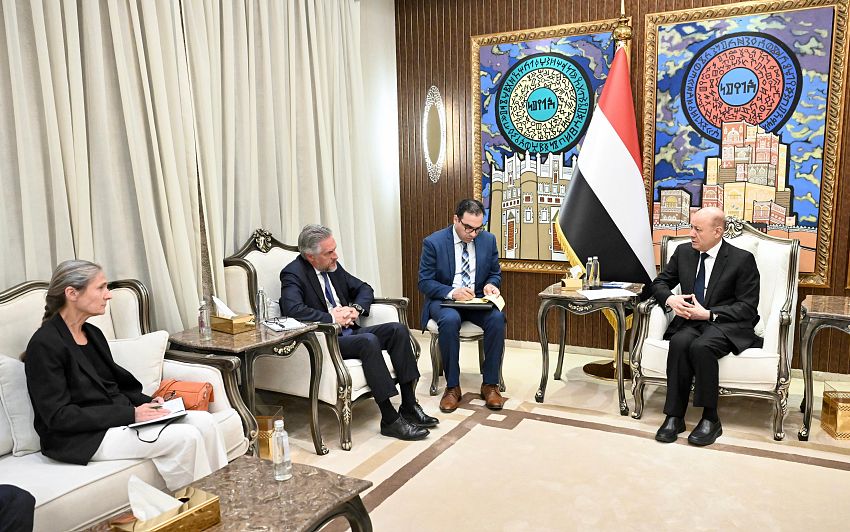
President Dr. Rashad Al-Alimi, President of the Presidential Leadership Council, received today, Wednesday, the National Commission to Investigate Alleged Violations of Human Rights (NCIAVHR), headed by Judge Ahmed Saeed Al-Muflehi, who presented the President with a copy of the Commission’s 14th report.
President Al-Alimi was briefed by the Commission’s chairman and members on its activities during the past period in documenting and investigating violations, referring cases to the judiciary, and inspecting prisons, detention centers, and sites where civilian casualties occurred. The briefing also covered the facilities and support required for the Commission to carry out its mandate under relevant national and international laws.
The briefing included the key findings of the Commission’s 14th periodic report, which documented 2,062 incidents of violations affecting 2,932 victims across various governorates. These included 501 incidents involving the killing and injury of civilians, resulting in the deaths of 193 civilians and injuries to 388 others.
The investigation findings attributed responsibility to the Houthi militias for 446 incidents involving the killing and injury of civilians, as well as for 56 of the 57 cases of child recruitment documented by the Commission during the reporting period.
The report also documented 534 cases of arbitrary detention and enforced disappearance, 371 of which were attributed to the Houthi militias. It further documented dozens of cases involving extrajudicial killings, torture and ill-treatment, forced displacement, the blowing up of homes, landmine planting, and attacks on civilian, religious, and medical objects. It also documented violations affecting women and attacks on commercial vessels in the Red Sea.
President Al-Alimi commended the national and professional role played by the National Commission to Investigate Alleged Violations of Human Rights, particularly at this exceptional stage. He said the Commission’s independence, impartiality, and professionalism are the source of its strength and credibility before the Yemeni people and the international community.
The President also addressed developments in the country over the past few days, including the wide-scale escalation by the Houthi militias, particularly in Taiz, Hodeidah, and the western coast. He noted that the escalation had triggered an unprecedented wave of displacement and attacks on civilian facilities and objects protected under international law. He noted, it included warehouses belonging to the United Nations and international organizations, as well as facilities of the King Salman Humanitarian Aid and Relief Center that serve hundreds of thousands of citizens.
President Al-Alimi stressed that these developments require the Commission, within its mandate and in accordance with its independence, to intensify urgent field monitoring and investigations into incidents linked to the escalation, particularly in Taiz, Hodeidah, Marib, and areas affected by hostilities.
“We want a documented national human rights record of the killing and starvation of civilians, displacement and forced displacement, attacks on homes and civilian, medical, and educational facilities, damage to displacement camps, landmine planting, and any other violations of international humanitarian law or international human rights law,” he added.
The President stressed the need to pay particular attention to what happens to civilians during displacement itself, including any attacks on displacement routes or civilian convoys, and to document the circumstances that forced families to leave their areas.
President Al-Alimi urged the National Commission to step up its efforts to expand its monitoring coverage across the country, in light of reports of arrests, arbitrary detention, and restrictions on humanitarian workers and civilians. He called for particular attention to cases of child recruitment, mobilization, enforced disappearance, and unlawful detention, and for such cases to be verified in accordance with the Commission’s standards.
President Al-Alimi explained that the Commission’s work is not merely about documenting the past, but also about protecting the present, preventing future violations. It is for laying the foundations for the justice and sustainable peace sought by all Yemenis.
The President affirmed that the state must conduct its struggle while upholding the law and investigating human rights violations, regardless of the party to which they are attributed. He noted that the war sparked by the terrorist militias is not a justification for suspending the law. Rather, the wider the scope of attacks, the greater the state’s responsibility to protect civilians and respect the rules of international humanitarian law.
“Our battle to restore state institutions is, at its core, a battle to restore the rule of law and protect human rights,” President Al-Alimi said. “The state whose institutions Yemenis are striving to restore must be the first to uphold the law.”
The President directed the government, local authorities, and relevant agencies to facilitate the National Commission’s work, including access for its monitors to all areas and to information falling within its mandate, in accordance with the law.
The meeting was attended by Dr. Yahya Al-Shuaibi, Director of the Office of the Presidency of the Republic.


PLC President: Holding Perpetrators of Grave Rights Violations Accountable Integral to Restoring State Institutions
President Dr. Rashad Al-Alimi, President of the Presidential Leadership Council, received today, Wednesday, the National Commission to Investigate Alleged Violations of Human Rights