
President Al-Alimi: Maritime Security Hinges on Strong Yemeni State Institutions and Terror Deterrence
Munich
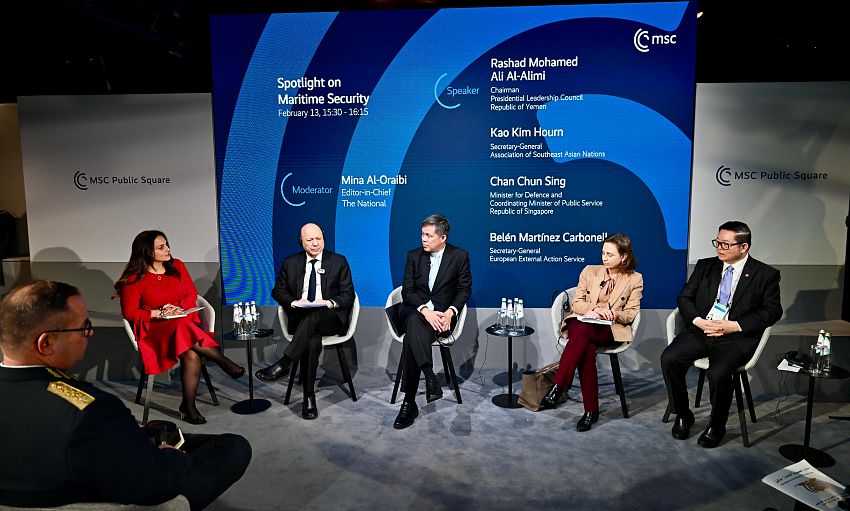
His Excellency Dr. Rashad Mohammed Al-Alimi, President of the Presidential Leadership Council, called for a new and comprehensive international approach to achieving regional stability and sustainable security for international navigation and maritime corridors, one that is based on deterrence rather than a policy of containing terrorists. He expressed hope that 2026 would mark a year of strengthened international partnership in building national institutions and ending terrorist threats.
Speaking at a dialogue session on maritime security held as part of the Munich Security Conference, which commenced on Friday, the President stressed that “achieving sustainable security for international navigation requires a different approach to the Yemeni issue. One that supports the rebuilding of state institutions and ensures deterrence against terrorist groups, rather than merely containing them or offering incentives.”
The President of the Presidential Leadership Council warned that the Houthi terrorist militias will remain a persistent threat to international and regional interests, as well as to national security, even if they temporarily halt their operations in the Red Sea.
He added that, “regrettably, terrorist acts in the Red Sea have in recent months been treated as a temporary security risk. Accordingly, the “Prosperity Guardian” initiative and the “Aspides” operation were launched. However, he noted that this tactical approach has led to the militarization of the region rather than its stabilization and has failed to address the root causes of the problem.”
The President considered the developments in the Red Sea and the Bab al-Mandab Strait to constitute a complex geopolitical dilemma. He said it is driven by multiple factors, including the activities of regional powers seeking dominance—foremost among them the Iranian regime—alongside the limited capacity of the Yemeni state to deter sabotage and combat terrorism, and the growing influence of non-state actors.
He emphasized that “the Houthi group should not be viewed separately from Al-Qaeda, Al-Shabaab, and ISIS, which he said have increasingly operated as a single destabilizing network on both shores of Bab al-Mandab.”
In this context, the President underscored that securing maritime navigation requires a broader international strategy grounded in respect for international legitimacy, state sovereignty, and territorial integrity, as well as enhanced support for fragile national governments—particularly in Yemen and Somalia—to enable them to fulfill their responsibilities. He also called for a proactive global counterterrorism strategy and for terrorist groups to be designated as a long-term geopolitical threat.
His Excellency encouraged the international community to activate regional frameworks in the Red Sea and Bab al-Mandab region through broader international partnerships to enhance regional stability, specifically the Council of the Red Sea Littoral States and the Combined Task Force 152.
He reiterated that securing international maritime navigation begins with consolidating security and stability within Yemen and adopting a joint deterrence strategy against armed groups to prevent cross-border terrorist operations.
The President also addressed the recent measures taken by the Yemeni government with the sincere support of the Kingdom of Saudi Arabia. He said these measures helped avert a catastrophic global scenario after an armed force attempted last December to rebel against state institutions, seize full control of Yemen’s southern coastline, and impose a divisive fait accompli backed by external powers.
His Excellency reaffirmed the need to strengthen Yemen’s international partnerships in this regard, stressing that the sustainability of global maritime security begins with stability on Yemeni soil.








PLC President: Decision to End Houthi Terrorism Is in Force and Irreversible
President Dr. Rashad Al-Alimi, President of the Presidential Leadership Council (PLC), affirmed that “Dawn of Yemen” Operation is proceeding toward its ultimate goal

PLC Warns Against Espionage and Cooperation with Houthis, Orders Pursuit of Those Involved
Tue ، 13 Oct 2026 04:56

PLC President Affirms Yemen’s Full Solidarity with Saudi Arabia, Vows to End Houthi Terrorism
Sat ، 10 Oct 2026 04:56

PLC President: “Dawn of Yemen” Operation to Continue Until All Its Objectives Are Achieved
Wed ، 07 Oct 2026 04:56