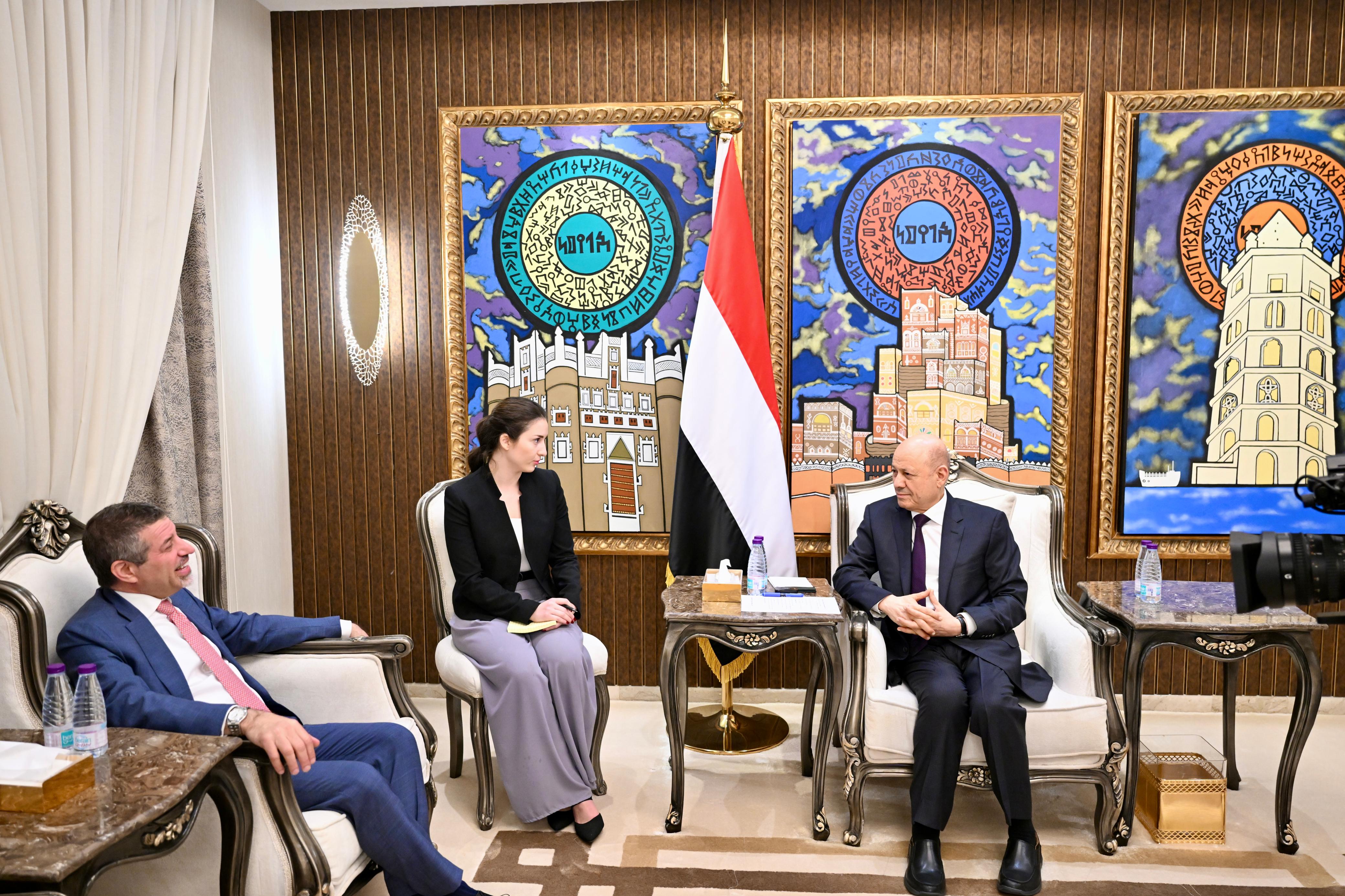
President of Presidential Leadership Council Receives US Ambassador
Riyadh
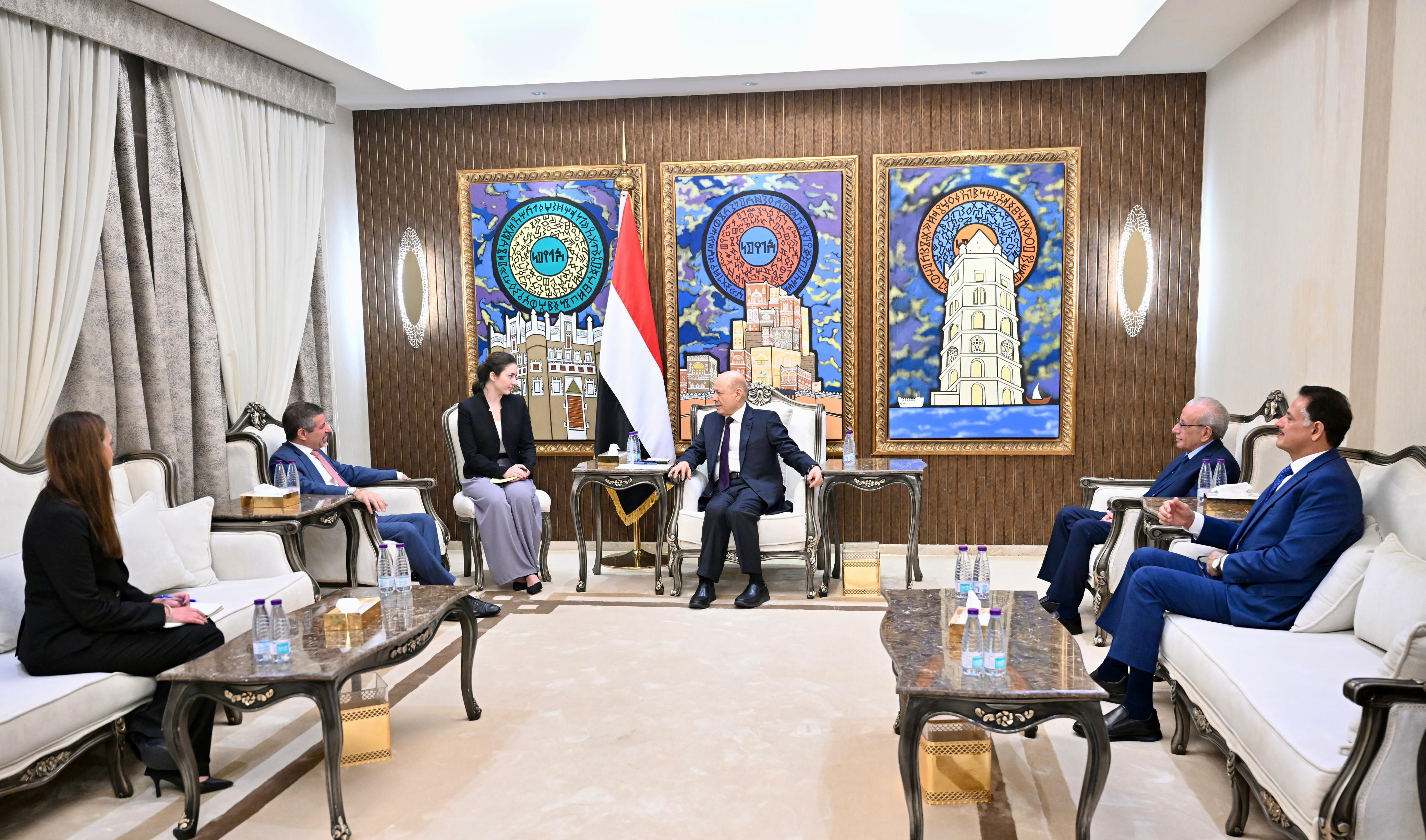
His Excellency President Dr. Rashad Mohammed Al-Alimi, President of the Presidential Leadership Council, received today, Monday, Mr. Steven Fagin, the Ambassador of the United States of America to Yemen.
The meeting discussed bilateral relations between the two friendly countries and ways to strengthen and develop them at various levels. It also reviewed recent local developments, including the latest situation in the eastern governorates, and the required U.S. support for government reform efforts. In addition, the talks addressed ongoing coordination in the fields of counterterrorism and deterring the Houthi militias backed by the Iranian regime, as well as terrorist organizations cooperating with them.
President Al-Alimi welcomed the notable progress in bilateral relations, expressing, on behalf of himself, the members of the Council, and the government, appreciation for the firm U.S. stances in support of the Yemeni state. He cited in particular the United States’ decision to designate the Houthi militias as a Foreign Terrorist Organization, efforts to counter weapons and financing smuggling networks linked to the Iranian regime, political support at the UN Security Council, and valued assistance for economic reform efforts.
The President reaffirmed the importance of continuing this active U.S. role in support of Yemen, its people, and its political leadership, and in helping achieve aspirations to restore state institutions, security, stability, and peace.
The meeting also addressed unilateral measures taken by the Southern Transitional Council in the eastern governorates. It also discussed the good offices of the Coalition to Support Legitimacy, led by the Kingdom of Saudi Arabia and the United Arab Emirates, aimed at de-escalation and restoring normal conditions in the two governorates to their previous state.
President Al-Alimi stressed the need to adhere to the governing references of the transitional phase and to the approach of partnership among the various political components within the framework of the legitimate government coalition. He warned of the repercussions of imposing unilateral measures outside the agreed references, foremost among them the Declaration of Transfer of Power and the Riyadh Agreement.
He noted that such measures could undermine the unity of security and military decision-making and affect the independence of the government. He cautioned that these actions could create vulnerabilities that may be exploited by the Houthi militias and allied terrorist organizations.
The President highly commended the efforts led by the Kingdom of Saudi Arabia to achieve de-escalation in Hadhramaut and Al-Mahra.
He affirmed that stability in the eastern governorates and the restoration of normal conditions are vital to Yemen’s security and stability, and constitute a natural extension of regional security and global energy supplies.
For his part, U.S. Ambassador Steven Fagin reaffirmed his country’s firm stance in support of Yemen’s unity, stability, and territorial integrity. He also emphasized Washington’s commitment to the unity of the Presidential Leadership Council and the government. He reiterated Washington’s strong partnership in counterterrorism efforts, alleviating the suffering of the Yemeni people, and supporting their aspirations at all levels.
The meeting was attended by Dr. Yahya Al-Shuaibi, Director of the Office of the Presidency of the Republic.

PLC President: Decision to End Houthi Terrorism Is in Force and Irreversible
President Dr. Rashad Al-Alimi, President of the Presidential Leadership Council (PLC), affirmed that “Dawn of Yemen” Operation is proceeding toward its ultimate goal

PLC Warns Against Espionage and Cooperation with Houthis, Orders Pursuit of Those Involved
Tue ، 13 Oct 2026 05:50

PLC President Affirms Yemen’s Full Solidarity with Saudi Arabia, Vows to End Houthi Terrorism
Sat ، 10 Oct 2026 05:50

PLC President: “Dawn of Yemen” Operation to Continue Until All Its Objectives Are Achieved
Wed ، 07 Oct 2026 05:50